
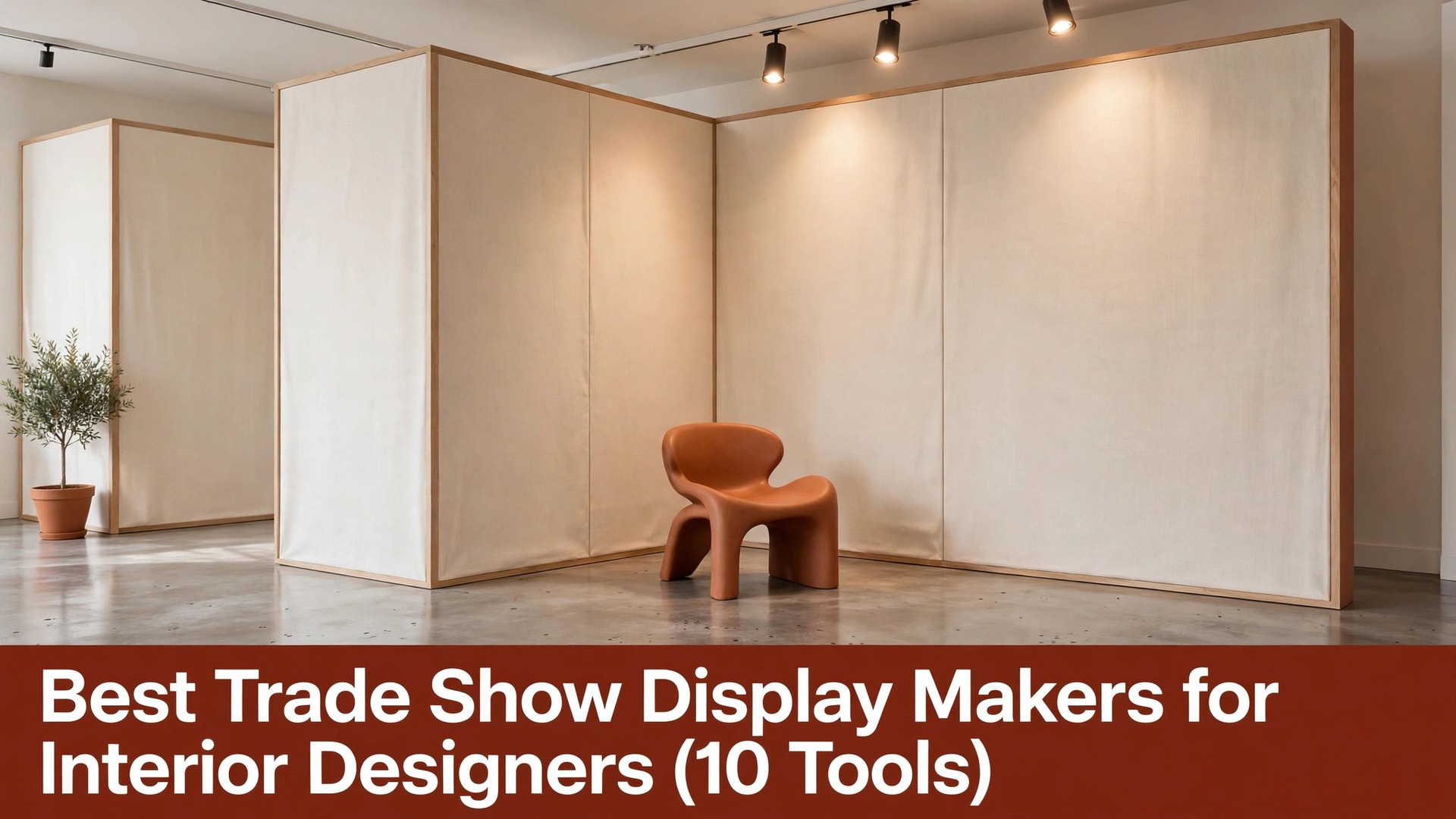
A trade show booth has about three seconds to stop a passer-by, and for interior designers that first glance is the whole pitch. The best trade show display makers for interior designers in this guide were judged on design quality, build practicality and how the finished booth photographs, because a display that looks good only in a render does not win clients on a crowded floor.
Every tool below was weighed on the same four questions for interior designers. Does it help design a booth that fits the brand, does it handle the physical build or the graphics well, does it travel and install without drama, and does it stay affordable for a small studio? A tool that scores well on all four earns its place here for interior designers.
Use the table to narrow the field to two or three names, then plan one real booth with each before paying. The rest of this guide walks through the costs, the mistakes to avoid, and the first week with a new display maker.
Quick jump
- Best Trade Show Display Makers for Interior Designers Compared Side by Side
- What Trade Show Display Makers Cost Interior Designers in 2026
- The 10 Trade Show Display Makers, One by One
- Best Pick by Job
- How to Choose the Right Trade Show Display Maker for Your Studio
- Trade Show Display Maker Mistakes That Cost Interior Designers Clients
- Your First Week With a New Trade Show Display Maker
- How to Keep Trade Show Display Maker Costs Down for Interior Designers
- How We Verified Every Trade Show Display Maker Price
- Frequently Asked Questions
- Habits That Keep Your Trade Show Display Maker Working for Interior Designers
- The Trade Show Display Maker Most Interior Designers Should Pick
Best Trade Show Display Makers for Interior Designers Compared Side by Side
Use the table below to compare the best trade show display makers for interior designers at a glance. Each row carries the price, the free tier and the best fit, so interior designers can cut the list to two or three names in minutes.
Shortlist from the table, then test. The reviews below the table carry the detail, but the table is where the decision starts for most interior designers.
| Tool | Best for | Free tier | Paid from |
|---|---|---|---|
| Nimlok | premium custom booths | Free consultation, no free product | Paid plans listed on the vendor site |
| Skyline Exhibits | custom booths with service | Free consultation, no free product | Paid plans listed on the vendor site |
| Exponents | standout booth design | Free consultation, no free product | Paid plans listed on the vendor site |
| Displays2go | affordable ready displays | Free design help on orders | Paid plans listed on the vendor site |
| APG Exhibits | modular display systems | Free consultation, no free product | Paid plans listed on the vendor site |
| Classic Exhibits | reusable modular booths | Free consultation, no free product | Paid plans listed on the vendor site |
| MOD Displays | lightweight portable displays | Free consultation, no free product | Paid plans listed on the vendor site |
| E&E Exhibit Solutions | full-service show support | Free consultation, no free product | Paid plans listed on the vendor site |
| Canva | booth graphics and signage | Free plan with design basics | $10 a month on annual billing ($120 a year) or $15 a month billed monthly |
| Adobe Express | quick booth graphics | Free plan with basic design | $9.99 a month |
What Trade Show Display Makers Cost Interior Designers in 2026
Prices for best trade show display makers for interior designers tools run from free to a monthly subscription, and the right budget depends on volume. A interior designers group with a heavy weekly load should price the yearly total, while a light user can often stay on a free plan for months.
The free plan is the cheapest way to learn a trade show display maker tool, but its limits decide the real cost. A cap on exports, seats or AI use can push a team onto a paid plan sooner than expected, so read the cap before you build a routine around the trade show display maker tool.
Count the learning time for the trade show display maker tool as part of the price. A trade show display maker tool that takes a day to learn costs a day, whatever the subscription says, so a slightly dearer tool that is ready in an hour can be the cheaper choice over a year.
One more cost to count for interior designers is the time spent switching trade show display maker tools. A trade show display maker tool that your interior designers abandon after a month wastes the setup hours as well as the subscription, so the cheapest best trade show display makers for interior designers choice is often the one the team actually keeps using.
The 10 Trade Show Display Makers, One by One
The best trade show display makers for interior designers below are reviewed in the same order as the table, with what each one does, what it costs, and where it falls short for interior designers.
1. Nimlok. Best for premium custom booths
Nimlok builds premium custom exhibits, from design through fabrication to installation on the show floor. It suits interior designers who want a booth that looks like their own work, because the design team builds to the brief. For interior designers who need premium custom booths, Nimlok keeps the setup short and the first result close at hand. Verdict for interior designers: Nimlok is worth testing first when premium custom booths is the priority.
The Free consultation, no free product from Nimlok covers a first real trade show display job, so a interior designer learns the limits before paying. Nimlok lists paid plans on its own site, so confirm the price before you pay.
Nimlok is a premium custom service, which matters for trade show display work on a small studio budget. Before interior designers commit to Nimlok, run one real job through it and see whether the limit actually bites. That limit is the one to test first, because it decides whether Nimlok fits real trade show display work.
2. Skyline Exhibits. Best for custom booths with service
Skyline Exhibits designs and builds custom booths and supports them with install and dismantle crews. It fits interior designers exhibiting in a new city, because the local team handles the parts a studio cannot. Skyline Exhibits fits interior designers who need custom booths with service, and the first version is usually ready in one sitting. Verdict for interior designers: Skyline Exhibits earns a test when custom booths with service tops the list.
Starting on the Free consultation, no free product shows a interior designer what Skyline Exhibits does well on a real trade show display task. Paid plans are published on the vendor site, so check the current price before paying for Skyline Exhibits.
Skyline Exhibits is a full-service custom builder, which matters for trade show display work that needs a quick, cheap option. For interior designers who lean on Skyline Exhibits every week, the limit is the first thing to check before paying. Run one real trade show display job through Skyline Exhibits before paying, and the limit will show itself quickly.
3. Exponents. Best for standout booth design
Exponents focuses on booths that stand out, with bold structures and graphics that draw visitors across the hall. It suits interior designers who want the booth itself to be the talking point, because the design leads the build. When interior designers need standout booth design, Exponents answers with a short setup and a result that is ready to use at once. Verdict for interior designers: put Exponents on the shortlist when standout booth design matters most.
With the Free consultation, no free product from Exponents, a interior designer can run a genuine trade show display job and judge the result before spending. Exponents publishes its paid plans on the vendor site, so confirm the price before you pay.
Exponents is a custom design service, which matters for trade show display work with a tight budget and a short deadline. A interior designer who plans to use Exponents often should weigh that limit against the paid plan before deciding. The limit above is the real price of Exponents, so weigh it against the trade show display work it must carry.
4. Displays2go. Best for affordable ready displays
Displays2go sells ready-made displays, banner stands and backwalls at prices a small studio can afford. It fits interior designers who need a reliable booth fast, because the products ship quickly and install simply. A interior designer who needs affordable ready displays will find Displays2go quick to learn, with the main controls visible from the start. Verdict for interior designers: Displays2go is the one to try first for affordable ready displays.
Displays2go offers Free design help on orders for a first trade show display job, which is enough to test it on honest work before paying. The vendor site carries the current paid plans for Displays2go, so confirm the price before you pay.
Displays2go sells standard products rather than custom builds, which matters for trade show display work that needs a unique shape. That trade-off matters most for interior designers who run Displays2go daily, so test it on a real trade show display job first. Before committing to Displays2go, check that limit against a week of real trade show display jobs.
5. APG Exhibits. Best for modular display systems
APG Exhibits builds modular display systems that reconfigure for different booth sizes and shows. It suits interior designers who exhibit often, because one system can serve several shows with new graphics. For interior designers who need modular display systems, APG Exhibits keeps the setup short and the first result close at hand. Verdict for interior designers: APG Exhibits is worth testing first when modular display systems is the priority.
The Free consultation, no free product from APG Exhibits covers a first real trade show display job, so a interior designer learns the limits before paying. APG Exhibits lists paid plans on its own site, so confirm the price before you pay.
APG Exhibits needs a design brief to quote, which matters for trade show display work that needs a fast price. Before interior designers commit to APG Exhibits, run one real job through it and see whether the limit actually bites. That limit is the one to test first, because it decides whether APG Exhibits fits real trade show display work.
6. Classic Exhibits. Best for reusable modular booths
Classic Exhibits is known for modular booths that can be rebuilt in many shapes from the same parts. It fits interior designers who exhibit twice a year, because the same kit serves both shows with different graphics. Classic Exhibits fits interior designers who need reusable modular booths, and the first version is usually ready in one sitting. Verdict for interior designers: Classic Exhibits earns a test when reusable modular booths tops the list.
Starting on the Free consultation, no free product shows a interior designer what Classic Exhibits does well on a real trade show display task. Paid plans are published on the vendor site, so check the current price before paying for Classic Exhibits.
Classic Exhibits is a trade supplier, which matters for trade show display work that needs a finished design service too. For interior designers who lean on Classic Exhibits every week, the limit is the first thing to check before paying. Run one real trade show display job through Classic Exhibits before paying, and the limit will show itself quickly.
7. MOD Displays. Best for lightweight portable displays
MOD Displays makes lightweight, portable exhibits that one person can carry and install. It suits interior designers travelling alone to a show, because the booth fits in a case and sets up in under an hour. When interior designers need lightweight portable displays, MOD Displays answers with a short setup and a result that is ready to use at once. Verdict for interior designers: put MOD Displays on the shortlist when lightweight portable displays matters most.
With the Free consultation, no free product from MOD Displays, a interior designer can run a genuine trade show display job and judge the result before spending. MOD Displays publishes its paid plans on the vendor site, so confirm the price before you pay.
MOD Displays focuses on portable systems, which matters for trade show display work that needs a large custom build. A interior designer who plans to use MOD Displays often should weigh that limit against the paid plan before deciding. The limit above is the real price of MOD Displays, so weigh it against the trade show display work it must carry.
8. E&E Exhibit Solutions. Best for full-service show support
E&E Exhibit Solutions handles design, build, shipping and install, so a studio can arrive and present. It fits interior designers who want one partner for the whole show, because the handover is a single conversation. A interior designer who needs full-service show support will find E&E Exhibit Solutions quick to learn, with the main controls visible from the start. Verdict for interior designers: E&E Exhibit Solutions is the one to try first for full-service show support.
E&E Exhibit Solutions offers Free consultation, no free product for a first trade show display job, which is enough to test it on honest work before paying. The vendor site carries the current paid plans for E&E Exhibit Solutions, so confirm the price before you pay.
E&E Exhibit Solutions is a full-service partner, which matters for trade show display work that only needs graphics. That trade-off matters most for interior designers who run E&E Exhibit Solutions daily, so test it on a real trade show display job first. Before committing to E&E Exhibit Solutions, check that limit against a week of real trade show display jobs.
9. Canva. Best for booth graphics and signage
Canva designs the graphics a booth needs, from backwall art to handouts, with templates sized for print. It suits interior designers who handle graphics in-house, because the brand kit keeps every piece consistent. For interior designers who need booth graphics and signage, Canva keeps the setup short and the first result close at hand. Verdict for interior designers: Canva is worth testing first when booth graphics and signage is the priority.
The Free plan with design basics from Canva covers a first real trade show display job, so a interior designer learns the limits before paying. Canva Pro charges $10 a month on annual billing ($120 a year) or $15 a month billed monthly.
Canva makes graphics, not physical displays, which matters for trade show display work that needs the build as well. Before interior designers commit to Canva, run one real job through it and see whether the limit actually bites. That limit is the one to test first, because it decides whether Canva fits real trade show display work.
10. Adobe Express. Best for quick booth graphics
Adobe Express builds booth graphics fast, with templates for banners, signs and handouts. It fits interior designers who need polished graphics the week before a show, because the templates do most of the work. Adobe Express fits interior designers who need quick booth graphics, and the first version is usually ready in one sitting. Verdict for interior designers: Adobe Express earns a test when quick booth graphics tops the list.
Starting on the Free plan with basic design shows a interior designer what Adobe Express does well on a real trade show display task. Adobe Express Premium is $9.99 a month.
Adobe Express makes graphics, not physical displays, which matters for trade show display work that needs the build as well. For interior designers who lean on Adobe Express every week, the limit is the first thing to check before paying. Run one real trade show display job through Adobe Express before paying, and the limit will show itself quickly.
Best Pick by Job
The table below matches the pick to the job, so interior designers can find their own situation and see the tool that fits it. The reasons here are short, because the trade show display maker reviews above already carry the full argument for interior designers.
| Job / Need | Pick | Why |
|---|---|---|
| Interior designers starting out | Canva | It handles first booth graphics cleanly and the free tier covers a first show of real designs. |
| Interior designers on a tight budget | Displays2go | It keeps display buying simple, so the work gets done without a long setup. |
| Interior designers who need speed | Nimlok | It suits trade show displays best on price, ease and output together. |
| Interior designers with a team to coordinate | Skyline Exhibits | It covers custom booths with the least setup of the tools in this guide. |
| Interior designers who want the best output | Exponents | It makes standout booths fast enough to fit a busy week of show preparation. |
| Interior designers ready to pay for quality | Classic Exhibits | It pairs modular displays with a booth that is ready to install at once. |
How to Choose the Right Trade Show Display Maker for Your Studio
Start from the weekly job, not the catalogue. The best trade show display makers for interior designers choice goes wrong when interior designers buy the longest feature list instead of the tool that fits the three tasks they repeat every week. List those three tasks first, then judge every trade show display maker candidate on them alone.
Price it over a year. The trade show display maker tool that looks cheap per month can cost more over twelve months once seats and add-ons are counted, so add up the full year before comparing two names. A trade show display maker tool that stays flat as the team grows usually wins.
Check the handover, not just the headline. A trade show display maker tool that lets a second person pick up the work without a long handover saves more time than any single feature, so ask how a half-finished job moves between people.
Run the free tier on a live job. A trade show display maker tool that survives one real deadline tells interior designers more than any demo, so test it on work that matters and watch where it slows down.
Check the renewal date, not just the price. A trade show display maker tool that renews silently at a higher rate can surprise interior designers a year later, so note the renewal date on the day you sign up. The best trade show display makers for interior designers pick should be one whose renewal you would still approve in twelve months.
Trade Show Display Maker Mistakes That Cost Interior Designers Clients
The most common trade show display maker mistake is buying the tool with the biggest name instead of the one that fits the job. Interior designers who copy a competitor’s choice inherit a workflow built for someone else’s team, so test the shortlist on your own work and ignore the brand.
Another costly error for interior designers is paying yearly on day one. A trade show display maker tool that has not proved itself on real work can turn a yearly plan into twelve months of regret, so pay monthly first and switch only when the tool has earned a place in the routine.
A third error for interior designers is skipping the export check on a trade show display maker tool. Interior designers who cannot move their work out of a trade show display maker tool are stuck with it whatever happens, so confirm the export format before the first real project depends on it.
A fourth error is letting the trade show display maker tool choose the workflow instead of the other way round. Interior designers who bend their trade show display maker process to fit a tool end up working for the software, so keep the process first and let the best trade show display makers for interior designers tool serve it.
Your First Week With a New Trade Show Display Maker
Start the first week with the job you do most often, because that is the task the trade show display maker tool must pass. A trade show display maker tool that handles the daily job well earns its place fast, while one that only shines on rare tasks will disappoint by Friday.
Write down what slows your trade show display maker work down each day during that first week. The notes show whether the trade show display maker tool is the problem or the workflow around it, and they make the end-of-week decision easy instead of a guess.
By day seven, judge the trade show display maker tool on three things only: speed, output quality and whether anyone else on the team could repeat the trade show display work. If all three pass, keep it; if one fails, try the next trade show display maker name on the shortlist.
On day three, try the trade show display maker tool’s hardest feature, not its easiest. A trade show display maker tool that handles the hard part well is worth keeping, while one that only does the easy half will force a second tool later, and interior designers who learn this early save a month.
How to Keep Trade Show Display Maker Costs Down for Interior Designers
The trade show display maker bill stays small when interior designers treat the tool as something to earn its keep, not a subscription to collect. Most readers of this guide can run the trade show display maker work on a free plan for months, and the tips below keep the paid bill low when the time to pay finally comes.
Use the free tier of the trade show display maker tool until a limit bites. Interior designers who pay on day one often pay for capacity that is never used, so keep the tool free until a real limit blocks a real job.
Pay monthly before paying yearly. A yearly plan looks cheaper per month, but it is a gamble before the tool has earned a place in the routine, so switch to yearly only when the trade show display maker tool has proved itself on real work.
Run one tool, not three. Interior designers who collect subscriptions for the same job pay three times for one result, so pick the strongest trade show display maker tool and cancel the rest.
Trim seats every quarter. Interior designers who leave former teammates on the bill pay for seats nobody uses, so remove them and watch the monthly total fall without losing any feature.
Export before you upgrade. A trade show display maker tool that charges for storage or exports can quietly raise the bill, so move finished work out regularly and keep the workspace lean.
Watch the add-ons. A trade show display maker tool that looks cheap can double in price once templates, extra seats or AI credits are added, so check the full bill before the first renewal.
How We Verified Every Trade Show Display Maker Price
Every price in this trade show display maker guide was checked on the vendor’s own pricing page where one was published, and the guide says plainly where a price could not be verified. Interior designers should still confirm the price before paying, because vendors change prices without notice.
The tools were compared on the same jobs for the same audience, so the ranking reflects daily use for interior designers rather than a list of features. A tool that finished real trade show display maker work cleanly outranked one that only looked strong on paper.
Frequently Asked Questions
How much floor space does a first trade show booth need?
Start with a ten by ten foot booth, because it fits a small display, a table and a conversation without overwhelming a first-time exhibitor. Nimlok and Skyline Exhibits both build well for that size, so plan the layout on paper before ordering anything.
Can an interior designer make trade show displays for free?
The graphics can be made free with tools like Canva and Adobe Express, though the physical display itself always costs money to build and ship. Design the graphics on a free tier first, then pay only for the physical build once the design is settled.
Does a display maker help an interior designer win clients?
It helps when the booth shows the designer’s own work clearly, because visitors hire the portfolio they can see. An interior designer who brings real project photos gains the most, because the booth becomes a walk-in portfolio.
What should an interior designer check before paying for a display?
Check the build material, the shipping weight, the install time and whether the graphics can be replaced for the next show. Displays2go and Classic Exhibits both publish these details, so confirm them on the vendor site before entering a card.
Which display maker suits a studio that exhibits twice a year?
Pick one with modular, reusable parts, because a booth that can be reconfigured saves the cost of a new build each time. Classic Exhibits and MOD Displays both build modular systems, so test both on the same booth plan and keep the one that reconfigures most easily.
Habits That Keep Your Trade Show Display Maker Working for Interior Designers
Save your best trade show display maker results as templates, because a good template turns a two-hour job into a twenty-minute one. Interior designers who rebuild from scratch each time pay the same learning cost again and again.
Check the trade show display maker bill every month, not just at renewal. A trade show display maker subscription that crept up through seats or add-ons is easy to miss, and a monthly glance catches it before a year of overpayment.
Keep one backup of finished trade show display maker work outside the tool. Interior designers who rely on a single platform lose everything when it changes its rules, so export finished work and keep it somewhere you control.
The Trade Show Display Maker Most Interior Designers Should Pick
For most interior designers, the best trade show display makers for interior designers pick that makes sense is Nimlok. It handles the daily trade show display maker job cleanly, its price is easy to justify, and the free tier lets you prove it on real work before paying.
Open Nimlok this week and run one genuine job through it. If the result is good enough to use, you have your answer; if it is not, the next trade show display maker name on the shortlist is waiting in the table above.