Interviews are won in practice, not on the day. The best AI interview prep tools for job seekers give you that practice on demand, with an AI interviewer that asks real questions, follows up on weak answers, and tells you exactly what to fix before the real thing.
The problem with practising alone is that you cannot hear your own filler words, rambling answers or nervous pace. These tools can. This guide compares ten prep tools on real prices, mock quality and feedback, and names the best pick for each job, so you walk into the interview already knowing what the hard questions sound like.
Quick jump
- Quick Answer. Best AI Interview Prep Tools for Job Seekers in 30 Seconds
- What Interview Prep Really Costs
- Interview Prep Mistakes That Waste the Practice
- A One-Week Interview Plan
- How to Use Feedback Properly
- How Many Mocks Do You Actually Need
- Preparing for Panel and Group Interviews
- After the Interview. What to Do Next
- How to Choose the Best AI Interview Prep Tools for Job Seekers
- Related Guides
- Frequently Asked Questions
- The Bottom Line
Quick Answer. Best AI Interview Prep Tools for Job Seekers in 30 Seconds
If you want the answer before the detail, here it is. Yoodli is the best pick for fixing how you speak, with a free Starter plan covering five role-plays and Pro at $8 a month billed yearly. Final Round AI is the best pick for realistic mock interviews, with plans from $25 a month billed yearly. Big Interview is the best pick for structured learning, with plans from $39.
The best AI interview prep tools for job seekers are the ones that give you feedback you can act on, not just a score. A tool that tells you which sentence rambled and how to fix it is worth more than a tool that gives you a number.
The rest of this guide proves that short answer, with a full comparison table, a detailed review of each tool with real prices, a guide to choosing, and answers to the questions job seekers ask most.
| Tool | Best for | Free tier | Paid from | Key strength |
|---|---|---|---|---|
| Yoodli | Fixing delivery and filler words | 5 role-plays | $8/mo billed yearly | Scores pace, clarity, fillers |
| Final Round AI | Realistic mock interviews | Limited trial | $25/mo billed yearly | Resume-based AI interviewer |
| Verve AI | Live interview help | 3 Copilot sessions, 5 mocks | $38.25/mo | Copilot plus mock practice |
| Big Interview | Structured interview courses | Free to browse | Plans from $39 | Curriculum plus practice |
| interviewing.io | Expert human mock interviews | Free AI interviewer | $179 per session | Senior engineer interviewers |
| Exponent | Product and behavioral mocks | Free to browse | About $12/mo billed yearly | Rubric-graded mocks |
| Huru | Quick AI mock interviews | Free tier | Paid plans from $19/mo | Instant feedback on answers |
| Google Interview Warmup | Free practice questions | Free | $0 | Free, no account needed |
| Mock Interview Pro | One-time voice mocks | Free interview plan | $39 one time | Pay once, practise for 30 days |
| ChatGPT | Talking through answers aloud | Free tier | $20/mo Plus | Voice mode practice anytime |
What Interview Prep Really Costs
The first surprise is how much good prep costs nothing. Google Interview Warmup is free, with no account and no card, and it covers the most common questions with feedback on your spoken answers. Yoodli gives you five free role-plays. interviewing.io gives you a free AI interviewer for coding and system design, plus free peer mocks. For a first interview, the free tier of two or three tools is often enough.
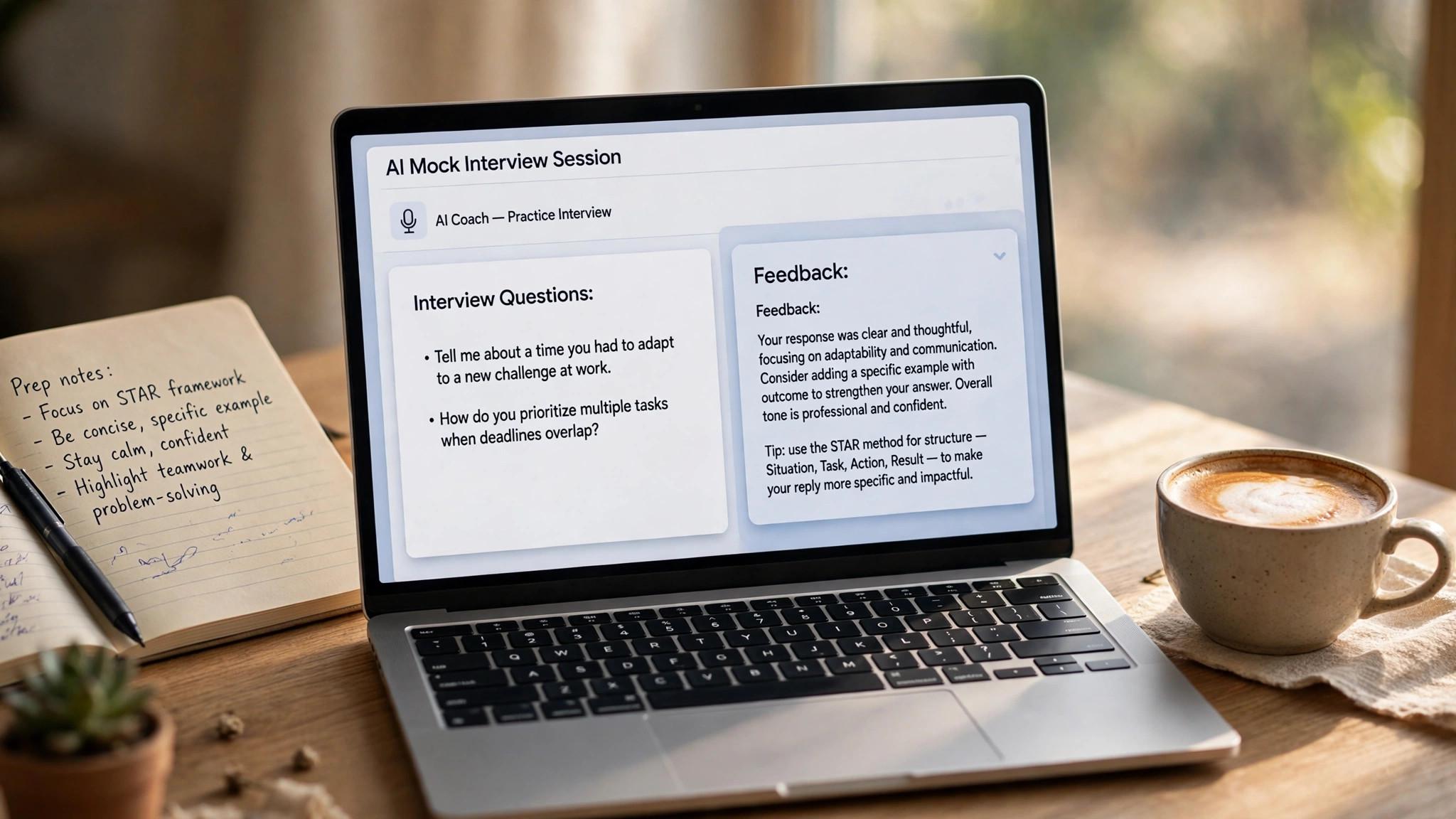
The second surprise is the price spread at the top. Final Round AI advertises plans from $25 a month, but that is the yearly plan billed upfront, and month-to-month access costs far more, with reviewers documenting about $150 a month. interviewing.io charges $179 per human mock session, which is expensive for one session and worth it for a final round at a top company. Know which price you are actually paying before you commit.

The third point is about the live copilot question. Final Round AI and Verve AI both sell live help during a real interview, where the AI listens and feeds you answers. Several large companies now treat that as a disqualifier, and getting caught can mean an offer withdrawn. Use these tools for practice, and treat the live copilot as a risk, not a shortcut.
1. Yoodli. Best for fixing delivery and filler words
Yoodli is the only tool here that scores how you say it, not just what you say. Its AI interviewer asks follow-up questions, then gives feedback on filler words, pace, eye contact on video, sentence structure and conciseness. If your answers ramble or you say the same filler word twenty times, Yoodli is the tool that will catch it.
Pricing starts with a free Starter plan covering five role-plays in total, with no card required. Pro costs $8 a month billed annually for up to ten role-plays a week, and Advanced costs $20 a month billed annually for unlimited role-plays.
What works. The delivery feedback is unique and specific, and the price is the lowest here. What to watch. It scores delivery, not answer content, so pair it with a tool that checks what you actually said.
2. Final Round AI. Best for realistic mock interviews
Final Round AI runs the most realistic AI mock interviews in this guide. It generates questions from your resume and the target role, asks them like a real interviewer, follows up on weak answers, and grades your performance in a debrief. Its flagship product is a live Interview Copilot that listens to a real interview and shows suggested answers in a private window.
Pricing is the most confusing here. The homepage advertises Pro from $25 a month, but that is the yearly plan billed upfront, and month-to-month costs about $150, according to reviewer reports. The plan page lists $25 a month billed yearly, $83.33 billed quarterly and $150 billed monthly. There is no free trial for live sessions.
What works. The mock interviews feel the most like a real interview, and the debrief is detailed. What to watch. The pricing is steep and login-gated, the Trustpilot rating is low with complaints about billing, and live copilot use carries a real risk with employers.
3. Verve AI. Best for live interview help
Verve AI combines mock practice with a live Interview Copilot, like Final Round AI, but at a lower price. Its copilot works across browser and desktop, and its mock mode gives you practice sessions with feedback before the real thing. It is the cheaper way into the copilot category, if that is what you want.
Pricing starts with a free tier covering three Copilot sessions and five mocks. Standard costs $38.25 a month on longer billing, or $44.99 month to month, and Pro costs $59.50 a month. Check the current figures at checkout, because the plan grid changes often.
What works. The price is about a third of Final Round AI for similar features, and the free tier is usable. What to watch. The same ethical caveat applies, because live help during a real interview can disqualify you with several large employers.
4. Big Interview. Best for structured interview courses
Big Interview is the curriculum option. Instead of jumping straight into mocks, it teaches you how to answer each question type, with video lessons, answer frameworks and practice sets, then lets you record answers and review them. It suits a job seeker who wants to learn the method before practising it.
Pricing starts free to browse, with paid plans from $39. The exact plan structure depends on whether you buy direct or through a school or employer, so check the current options on the pricing page before you commit.
What works. The teaching is the most structured here, and the frameworks work for any role. What to watch. It is less realistic than an AI interviewer that follows up, so pair it with Yoodli or a mock tool for live practice.
5. interviewing.io. Best for expert human mock interviews
interviewing.io is the only tool here where the interviewer is a real senior engineer. Its paid mocks pair you with an interviewer from a top company who runs a realistic coding or system design round and gives you honest feedback. Its free AI interviewer covers coding and system design practice, and its peer mocks are free too, though quality varies.
Pricing starts free for the AI interviewer and peer mocks. Human mock interviews cost $179 per session, with the price climbing if you want an interviewer from a specific top company or a hiring manager rather than a senior engineer.
What works. A human expert catches things no AI can, and the feedback is brutally honest. What to watch. One session costs more than a month of most rivals, so save it for the final round, not the first practice.
6. Exponent. Best for product and behavioral mocks
Exponent, now rebranding to Aced, is the specialist for product management and behavioral interviews. Its mocks are rubric-graded, which means your answers are scored against a clear standard, and its question bank covers the product cases and behavioral stories that general tools handle badly. It is the best pick for product roles.
Pricing starts free to browse, with paid plans at about $12 a month billed annually. Check the current price at checkout, because the rebrand to Aced is changing plan names and pricing.
What works. The rubric grading is specific and fair, and the product question bank is deep. What to watch. It is built for product and behavioral rounds, so engineers need a different tool for technical practice.
7. Huru. Best for quick AI mock interviews
Huru is the fast option. You paste a job description, pick a question set, and start a mock interview in minutes, with instant feedback on your answers. It suits a job seeker with an interview tomorrow who needs one focused practice session tonight, not a six-week course.
Pricing starts with a free tier, and paid plans start from around $19 a month. Check the current figures at checkout, because plan names and limits change often.
What works. The setup is the fastest here, and the feedback is immediate. What to watch. The feedback is thinner than Yoodli or Final Round AI, so use it for volume practice, not for deep coaching.
8. Google Interview Warmup. Best for free practice questions
Google Interview Warmup is the free tool everyone should start with. It asks the most common interview questions, listens to your spoken answers, and gives feedback on job-related terms, filler words and talking points, with no account and no card. It was built by Google for job seekers, and it costs nothing.
Pricing is $0, with no paid tier at all. The tool is free forever, and it works in the browser with no install.
What works. It is free, fast and genuinely useful, and the talking-points feedback is smart. What to watch. The question set is general, so it cannot prepare you for role-specific or technical rounds.
9. Mock Interview Pro. Best for one-time voice mocks
Mock Interview Pro is the pay-once option. Its voice interviewer builds questions from your posting, follows up on what you say, and rewrites your weakest sentence. You pay once for 30 days and three voice mock interviews, with a 14-day refund, which makes it the cheapest way to get real voice practice without a subscription.
Pricing is $39 one time for 30 days and three voice mock interviews. A one-year pass costs $59 and gives unlimited voice interviews for 365 days, which is about a fifth of Final Round AI’s yearly charge.
What works. The one-time price is excellent value, and the sentence rewrites are genuinely helpful. What to watch. The free plan covers a written interview plan only, so voice practice needs the paid pass.
10. ChatGPT. Best for talking through answers aloud
ChatGPT in voice mode is the most flexible practice partner here. You can ask it to interview you for a specific role, answer aloud, get feedback, and ask it to rephrase your weakest answer. It handles career changes, gaps and unusual backgrounds well, because it works from your story rather than a script.
Pricing starts with a free tier, and Plus costs $20 a month. Plus adds faster responses, more usage and better voice features, which matter when you want a long practice session without interruptions.
What works. The practice is unlimited and flexible, and the rephrasing is strong. What to watch. It is a general assistant, not a specialist, so its feedback is less structured than Yoodli or Exponent.
Interview Prep Mistakes That Waste the Practice
The first mistake is practising in your head. Reading answers silently does not prepare you for speaking them, and the first time you hear your own voice should not be in the real interview. Practise out loud, on camera, with a real tool, and watch the recording back, because the gap between what you think you said and what you actually said is where the improvement lives. The second mistake is memorising answers. An AI interviewer asks follow-ups, and a memorised answer falls apart on the second question, because you cannot memorise every follow-up. Learn the material, prepare the stories, and practise explaining them simply, so you can answer the follow-up as well as the first question. The third mistake is practising generic questions when the role needs specific ones. A software engineer who practises tell me about yourself and never practises system design is preparing for the wrong interview, and a product manager who practises brain teasers and never practises a product case is doing the same. Paste the actual job description into the tool and practise the questions that role will ask. The fourth mistake is doing ten mocks and fixing nothing. A mock without a fix list is entertainment, not preparation, and the value of a practice session is in the three things you change afterwards. After every mock, write down the three weakest answers, rewrite them, and practise the rewrites before the next session.
A One-Week Interview Plan
Day one is for the diagnosis. Record yourself answering three common questions, listen back, and list the weaknesses, whether they are filler words, rambling, or thin answers. Day two and three are for the fix, with Yoodli free for delivery and Google Interview Warmup free for the questions, one session each day. Day four is for the role-specific practice. Paste the job description into the tool and practise the questions that role will ask, with a real example for each one. Day five is for the dress rehearsal, in the real setup, with the same clothes, lighting and camera, answering three questions out loud. The weekend is for rest and review. Watch the rehearsal recording once, note the one thing that still needs work, and fix it on Monday. Three focused sessions in a week will change how you walk into the room, and a plan that fits in a week is a plan you will actually follow. Do not practise the day before the interview. A light review of your three strongest stories is enough, and a heavy practice session the night before adds nerves without adding skill. Rest, sleep, and trust the preparation you already did.
How to Use Feedback Properly
Feedback is only useful if you act on it, and the way to act on it is to fix one thing at a time. A feedback report with twenty suggestions is overwhelming, and a job seeker who tries to fix all twenty fixes none of them. Pick the three biggest issues, fix those, and ignore the rest until the next session. Separate delivery feedback from content feedback. Yoodli tells you about filler words, pace and clarity, which is delivery, and Final Round AI tells you about answer structure and relevance, which is content. Fix delivery first, because a well-delivered average answer beats a poorly delivered good answer, and the delivery fix is faster. Track the feedback across sessions. Write down the filler count, the pace score and the structure score after each mock, and watch whether they improve. A trend that improves is proof the practice works, and a trend that does not improve tells you the practice is wrong, not that you are. Ask a human for feedback too, before the final round. An AI tool catches filler words and structure, but a human catches nuance, body language and story quality that AI misses. Use AI for the reps and a human for the final polish, especially before the interview that matters most.
How Many Mocks Do You Actually Need
Three to five focused mocks is enough for most roles. One to learn the format, one to fix your weakest answers, and one or two to practise the real questions for that specific role. More than that has diminishing returns, and the time is better spent researching the company, because a candidate who knows the company beats one who has done ten generic mocks. The mocks should get harder, not just more numerous. The first mock can be general questions, the second should use the real job description, and the third should be a dress rehearsal in the real setup, with the same clothes, lighting and camera. A mock that is harder than the real interview makes the real one feel easy, and a mock that is easier teaches nothing. Space the mocks out. One mock a day for five days beats five mocks in one day, because the brain needs time to absorb the feedback and rewrite the answers. A mock, a fix, and a rest is the rhythm that works, and a marathon of mocks in one afternoon produces fatigue, not skill. Stop mocking when the answers are stable. A candidate whose answers are consistent, concise and structured is ready, and more mocks will only add nerves. The sign of readiness is not a perfect score, it is the feeling that you have answered the hard questions before, because you have, three times already.
Preparing for Panel and Group Interviews
A panel interview is a different skill from a one-to-one, because you must address the whole room, not just the person who asked. Practise answering while looking at the camera, then glancing at the other faces, so every panel member feels included. An AI mock with follow-ups is good preparation, because it teaches you to handle the second question, which is where panel interviews get hard. Prepare a story for each panel member role. The hiring manager asks about results, the peer asks about collaboration, and the senior leader asks about judgment, and a candidate with a story for each one is ready for all three. Read the panel list before the interview, and match a story to each name. Take notes during the panel, with the name of each person and the question they asked, so your follow-up message can reference something specific from each conversation. A thank-you note that mentions three people by name is memorable, and one that says thank you for your time is forgettable. The notes are the raw material for the follow-up. Do not favour one panel member over the others. A candidate who only looks at the hiring manager alienates the peers, and the peers often have a vote. Address the whole room, answer the person who asked, and glance at the others, because the interview is a group decision, even when one person leads it.
After the Interview. What to Do Next
Write down the questions you were asked and how you answered, while it is fresh, because the notes help you prepare for the next round and help you follow up with a thank-you message that references something specific. A candidate who remembers the conversation is a candidate who cares, and the notes prove it. Send a thank-you message within a day, to each interviewer if you have their details, referencing one thing from the conversation. A short message that says thank you for the discussion about the onboarding project, and here is the link I mentioned, is memorable, and a generic thank-you is not. The follow-up is part of the interview, not an afterthought. Do not stop applying while you wait. The biggest mistake after a good interview is stopping the search and waiting for an offer that may never come, because the pipeline goes cold and the advantage disappears. Keep twenty live applications in the pipeline until the offer is signed, because a search ends when the contract is signed, not when the interview goes well. Ask for feedback if you are rejected, politely and once, because the answer tells you what to fix for the next interview. Most employers will not give detailed feedback, but some will, and one honest sentence about a weak answer is worth more than ten mocks. The rejection is data, and data makes the next interview better.
How to Choose the Best AI Interview Prep Tools for Job Seekers
Step 1. Work out what is actually weak. Record yourself answering three common questions and listen back. If you ramble or use filler words, start with Yoodli. If your answers are short but thin, start with Big Interview or Exponent. If you freeze under pressure, start with Final Round AI mocks. The tool should match the weakness, not the marketing.
Step 2. Start with the free tier. Google Interview Warmup is free, Yoodli gives you five free role-plays, and interviewing.io gives you a free AI interviewer. Run one practice session in each before you pay for anything, and only pay for the tool that gave you feedback you could act on.
Step 3. Practise the real questions, not generic ones. Paste the actual job description into the tool and practise the questions that role will ask. Generic practice helps with confidence, but role-specific practice is what changes the result. Spend one session on your top three roles, not ten sessions on random questions.
Step 4. Practise out loud, on camera. Reading answers silently does not prepare you for speaking them. Use voice mode, turn the camera on, and watch the recording back. The gap between what you think you said and what you actually said is where the improvement lives.
Step 5. Skip the live copilot. Live AI help during a real interview is a risk, not a shortcut. Several large companies treat it as a disqualifier, and getting caught can mean an offer withdrawn. Practise hard, then walk in clean and answer for yourself.
Related Guides
- Best AI Job Application Tools for Job Seekers
- Best AI Resume Builders for Tech Jobs
- Best AI Tools for Freelancers Finding Clients
Frequently Asked Questions
How many mock interviews should I do before a real one?
Three to five focused mocks is enough for most roles. One to learn the format, one to fix your weakest answers, and one or two to practise the real questions for that specific role. More than that has diminishing returns, and the time is better spent researching the company. That is the value of best ai interview prep tools for job seekers. A tool that fits the job beats a tool that promises everything.
Is Final Round AI worth the price?
Final Round AI is worth it if you want the most realistic AI mocks and you buy the yearly plan at $25 a month billed upfront. Month-to-month at about $150 is hard to justify, and the billing complaints on Trustpilot mean you should read the terms carefully before you pay. Yoodli at $8 a month is the better value for most job seekers. The test for any best ai interview prep tools for job seekers is simple. Does it fix the step where your search breaks down?
Can AI interview prep replace a human coach?
No, and it should not try to. AI tools are excellent for volume practice, filler words and structure, but a human coach catches nuance, body language and story quality that AI misses. Use AI for the reps and a human for the final polish, especially before a final round. The right pick among best ai interview prep tools for job seekers is the one you will actually use every week, not the one with the longest feature list.
What is the best free interview prep tool?
Google Interview Warmup is the best free tool, because it costs nothing, needs no account, and gives real feedback on spoken answers. Yoodli is the best free specialist, with five free role-plays. interviewing.io is the best free technical option, with a free AI interviewer for coding and system design.
Should I use a live AI copilot during a real interview?
No. Several large companies now treat live AI assistance during an interview as a disqualifier, and getting caught can mean an offer withdrawn on the spot. Use these tools for practice, where they are excellent, and answer for yourself in the real interview.
The Bottom Line
Yoodli is the best pick for fixing how you speak, Final Round AI is the best pick for realistic mock interviews, and Big Interview is the best pick for structured learning. The best AI interview prep tools for job seekers are the ones that give you feedback you can act on, so start free, find your weakness, and practise the real questions out loud. Start with the free tier, and let best ai interview prep tools for job seekers prove itself on one real role before you pay.
Book one practice session today, even a free one. Record yourself, listen back, and fix one thing before the next session. Three focused mocks will change how you walk into the room, and that is the whole point of preparing. Used well, best ai interview prep tools for job seekers saves hours every week, and the time saved is the real return on the price.
1 thought on “Best AI Interview Prep Tools for Job Seekers”