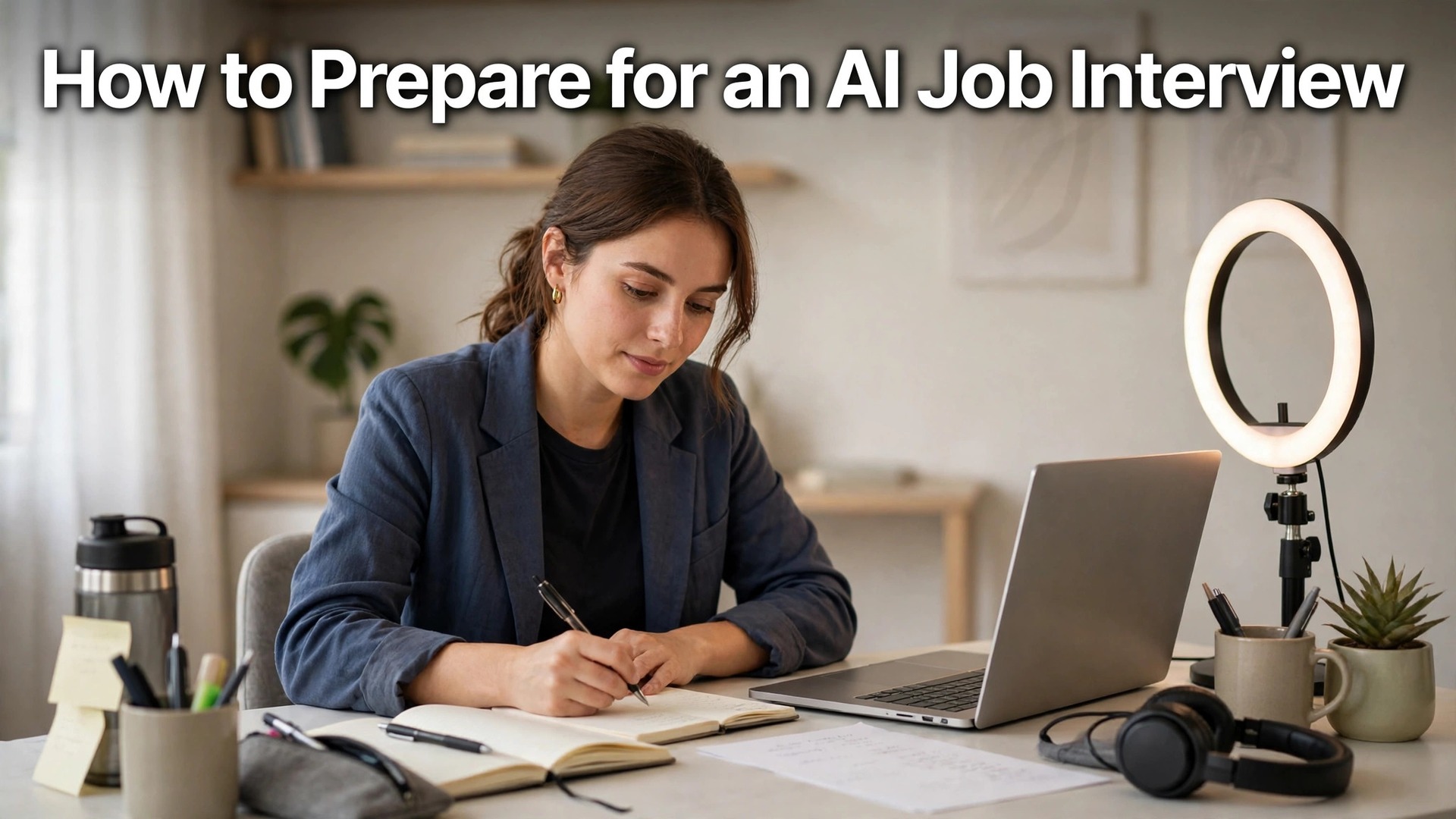
An AI job interview is not a normal interview with a camera on. How to prepare for an AI job interview means preparing for two different formats, the one-way recorded interview where you answer questions alone, and the live AI interviewer that asks follow-ups and scores your answers in real time.
Most candidates fail AI interviews for the same reason. They prepare answers, but they never practise saying them out loud, on camera, under time pressure, and the first time they hear their own voice is in the real interview. This guide shows you how to prepare step by step, so the real thing feels like the fifth practice, not the first.
Quick jump
- Quick Answer. How to Prepare for an AI Job Interview in 30 Seconds
- The Tools That Help, and What Each One Does
- Mistakes That Cost Candidates the Interview
- One-Way vs Live Interview Prep
- Body Language on Camera
- Preparing for Behavioural Questions
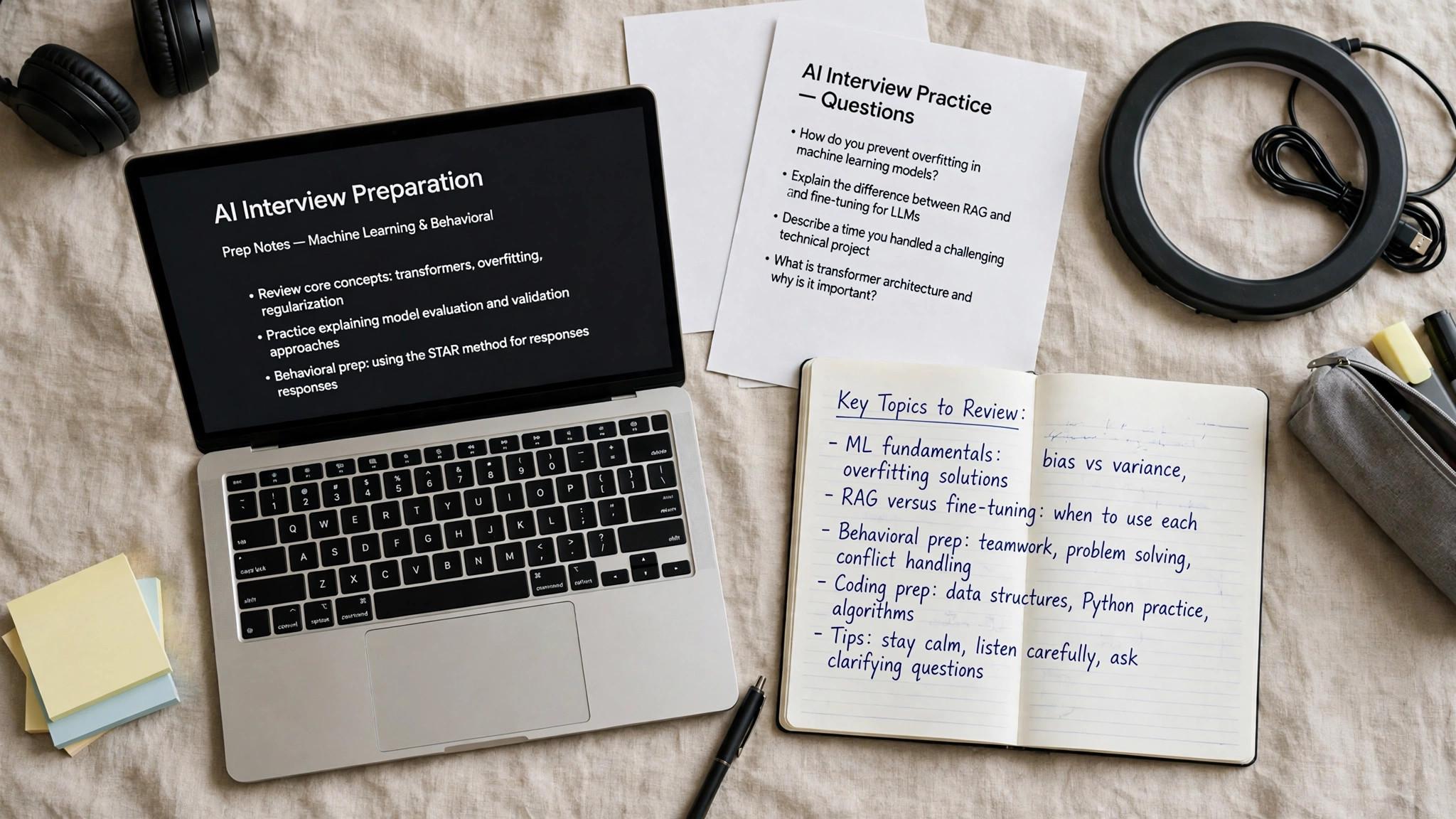
- Preparing for Technical Interviews
- What to Wear and How to Set Up
- How to Prepare for an AI Job Interview
- Related Guides
- Frequently Asked Questions
- The Bottom Line
Quick Answer. How to Prepare for an AI Job Interview in 30 Seconds
If you want the short version, here it is. Learn which format you face, one-way or live, then practise out loud on camera with Yoodli free or Google Interview Warmup, fix your weakest three answers, and do a full technical check the day before. Three focused practice sessions will change how you walk into the interview, and the preparation takes a week, not a month.
How to prepare for an AI job interview comes down to three moves, which are know the format, practise out loud, and fix what the feedback flags. The rest of this guide shows you each move in detail, with the tools and the steps.
The steps below work for both formats, with notes where one-way and live interviews differ. If you do not know which format you face, ask the recruiter, because the preparation is different, and guessing wrong wastes the week.
Step 1. Find Out Which Format You Face
Ask the recruiter which format the interview uses, because one-way and live AI interviews need different preparation. A one-way interview records your answers to pre-set questions, usually with a time limit per answer and a chance to re-record. A live AI interviewer asks questions, follows up on your answers, and scores you in real time, much like a human interviewer.
Read the invitation carefully for clues. A link to a recording platform, a time limit per question, and a note about re-recording all point to a one-way interview. A calendar invite with a live session, a named AI interviewer, and a note about follow-up questions all point to a live interview. If the invitation does not say, ask, because the recruiter expects the question and the answer changes your preparation.
Prepare for the format you face, not for both at once. A one-way interview rewards concise, structured answers that fit the time limit, and a live interview rewards answers that invite follow-up and show depth. Practising the wrong format is worse than not practising, because it builds the wrong habits.
Step 2. Research the Role and the Company
Read the job description twice and note the three requirements that matter most, then research the company, its products, its recent news, and its values. An AI interviewer asks questions built from the posting, so the requirements are the question list, and a candidate who knows them can predict most of the interview before it starts.
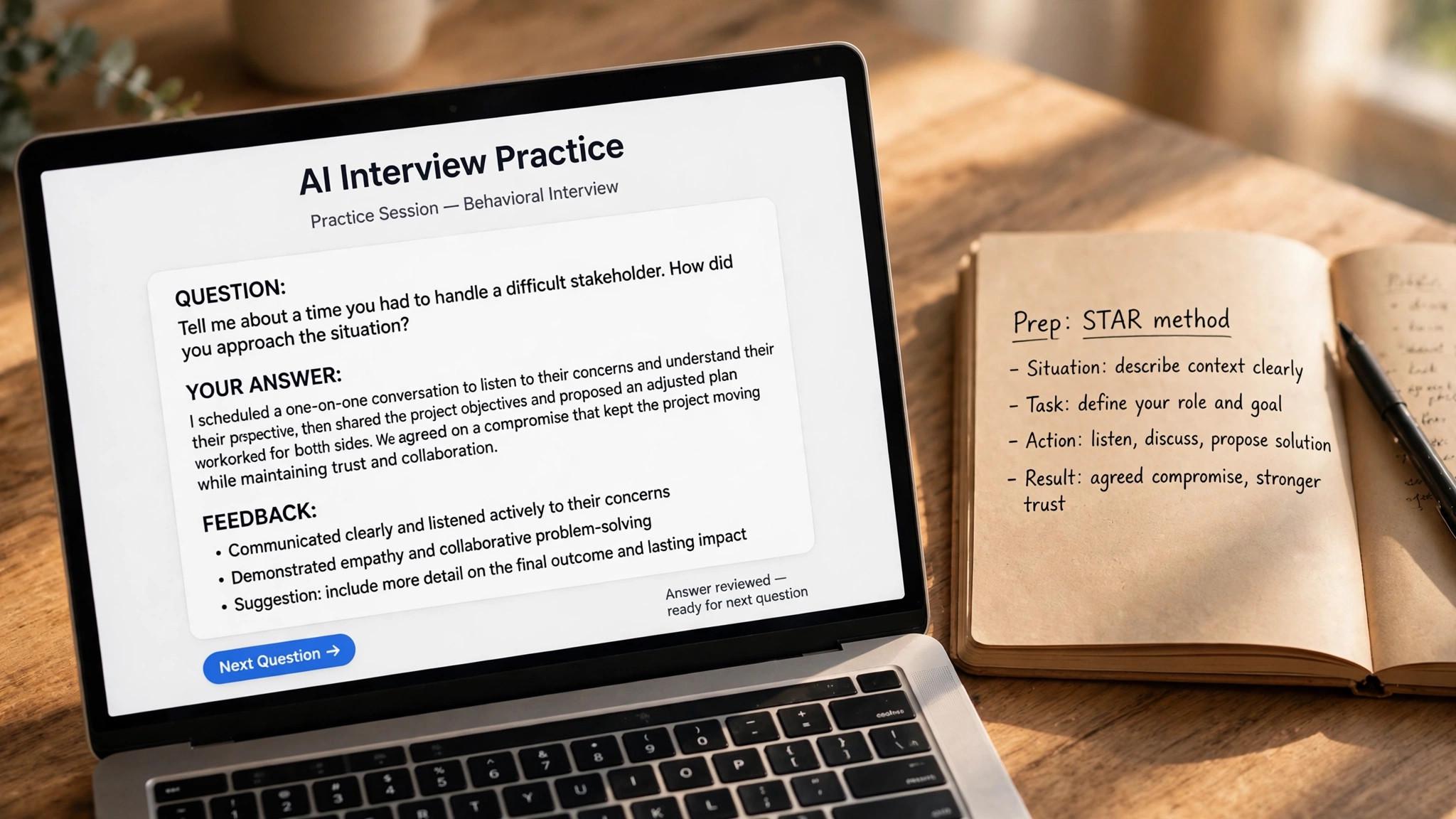
Prepare a story for each requirement, using the STAR method, which is situation, task, action and result. Each story should take ninety seconds to tell, with a real result and a number where you have one. Three strong stories cover most behavioral questions, and the AI will score the structure as well as the content.
Learn the company well enough to answer why this role, why this company, and why now, in two sentences each. An AI interviewer scores generic answers low, and a specific answer with a real detail about the company scores high, because it proves you cared enough to learn.
Step 3. Practise Out Loud, On Camera, with a Real Tool
Practise with a real tool, not in your head. Google Interview Warmup is free, with no account and no card, and it asks the most common questions with feedback on your spoken answers. Yoodli gives you five free role-plays, with feedback on filler words, pace and clarity. Use both, because Warmup covers the questions and Yoodli covers the delivery.
Practise out loud, on camera, in the same setup you will use for the real interview. Sit at the desk, turn on the ring light, look at the camera, and answer as if the interviewer is there. Reading answers silently does not prepare you for speaking them, and the gap between what you think you said and what you actually said is where the improvement lives.
Record every practice session and watch it back. Look for filler words, rambling answers, nervous pace, and eyes that wander from the camera. The recording is honest in a way your memory is not, and one watched recording teaches more than five unrecorded practices.
Step 4. Fix Your Weakest Three Answers
After two practice sessions, list your three weakest answers, the ones that rambled, lacked a result, or used the most filler words. Rewrite each one using the STAR method, with a clear situation, a specific action, and a result with a number. Then practise each rewritten answer three times, out loud, until it flows without notes.
Cut every answer to under two minutes. An AI interviewer scores concise, structured answers higher than long ones, and a two-minute answer with a clear result beats a four-minute answer that wanders. If an answer takes longer than two minutes to tell, it has too much setup and not enough result, so cut the setup first.
Test the rewritten answers in a fresh practice session, and check whether the feedback improved. If the filler words dropped and the structure score rose, the fix worked. If not, rewrite again, shorter and simpler, because the best interview answers are simple, specific and short.
Step 5. Prepare for the Technical and Role-Specific Questions
Technical and role-specific questions need different preparation from behavioral ones. For a technical role, practise the core skills the posting names, using interviewing.io free AI interviewer for coding and system design, or Exponent for product cases. For a non-technical role, prepare the three hardest questions in your field, and practise answering them with a real example.
Do not memorise answers. An AI interviewer asks follow-ups, and a memorised answer falls apart on the second question, because you cannot memorise every follow-up. Learn the material well enough to talk about it, then practise explaining it simply, as if to a smart colleague who does not know your field.
Prepare one question to ask at the end, about the team, the role, or the work, because an AI interviewer scores that too, and a thoughtful question shows interest. A generic question about culture scores low, and a specific question about a product or a challenge scores high.
Step 6. Do a Full Technical Check the Day Before
Test everything the day before, not the morning of the interview. Check the camera, the microphone, the lighting, the internet connection, and the platform, in the exact setup you will use. Close every other app, silence notifications, and make sure the background is clean and the light is on your face, not behind you.
Do a full dress rehearsal in the real setup, with the same clothes, the same chair, and the same lighting, answering three questions out loud. The rehearsal catches problems a checklist misses, such as a chair that squeaks, a light that glares, or a microphone that picks up the fan.
Prepare a backup plan. Keep a phone hotspot ready in case the internet drops, keep the recruiter contact details on paper in case the platform fails, and know what to do if the session disconnects. A calm response to a technical problem scores better than a panicked one, and the backup plan is what keeps you calm.
Step 7. On the Day, Slow Down and Answer for Yourself
On the day, arrive early, breathe, and slow down. AI interviews reward a steady pace and clear structure, and the most common mistake is speaking too fast under pressure. Pause before each answer, take a breath, and start with the point, not the background, because the first sentence sets the score for the whole answer.
Answer for yourself, without live AI help. Several large companies now treat live AI assistance during an interview as a disqualifier, and getting caught can mean an offer withdrawn. Use the preparation tools before the interview, where they are excellent, and answer for yourself in the real thing, where honesty is the only safe strategy.
After the interview, write down the questions you were asked and how you answered, while it is fresh. The notes help you prepare for the next round, and they help you follow up with a thank-you message that references something specific from the conversation.
The Tools That Help, and What Each One Does
Yoodli is the best tool for delivery, with a free Starter plan covering five role-plays and Pro at $8 a month billed yearly. It scores filler words, pace, eye contact and clarity, which is the feedback most candidates need. Google Interview Warmup is the best free tool, with no account and no card, covering the most common questions with feedback on spoken answers.
Final Round AI is the best tool for realistic mocks, with plans from $25 a month billed yearly, though month-to-month costs about $150, and its billing has drawn complaints. interviewing.io is the best tool for technical roles, with a free AI interviewer for coding and system design and human mocks at $179 a session. Exponent is the best tool for product and behavioral rounds, at about $12 a month billed annually.
Use two tools, not five. Warmup plus Yoodli covers most candidates, and a specialist covers the rest. More tools mean more practice, but only if you use them, and three focused sessions on one tool beat ten scattered sessions on five.
Mistakes That Cost Candidates the Interview
The first mistake is practising in your head. Reading answers silently does not prepare you for speaking them, and the first time you hear your own voice should not be in the real interview. Practise out loud, on camera, with a real tool, and watch the recording back.
The second mistake is memorising answers. An AI interviewer asks follow-ups, and a memorised answer falls apart on the second question. Learn the material, prepare the stories, and practise explaining them simply, so you can answer the follow-up as well as the first question.
The third mistake is using live AI help during the real interview. Several large companies treat it as a disqualifier, and getting caught can mean an offer withdrawn on the spot. Prepare hard, then walk in clean and answer for yourself.
One-Way vs Live Interview Prep
A one-way interview records your answers to pre-set questions, usually with a time limit per answer and a chance to re-record. Prepare concise, structured answers that fit the time limit, practise with a timer, and use the re-record option when it is offered, because the first take is rarely the best. The skill is brevity, and the practice is saying the same answer shorter each time.
A live AI interviewer asks questions, follows up on your answers, and scores you in real time. Prepare to explain your thinking, not just to state it, because the follow-up will ask why, and a candidate who can explain the reasoning scores higher than one who can only state the result. Practise with a tool that asks follow-ups, such as Yoodli or Final Round AI, because a tool that only asks pre-set questions does not prepare you for the live format.
The body language differs too. A one-way interview lets you look at notes between questions, because no one is watching live, and a live interview tracks eye movement, so looking away reads as disengagement. Practise in the format you face, with the same setup, so the habits you build are the habits the format rewards.
Ask the recruiter which format you face, because the preparation is different, and guessing wrong wastes the week. The invitation usually says, and if it does not, ask, because the recruiter expects the question and the answer changes everything you practise.
Body Language on Camera
Look at the camera, not at the screen, because the camera is the interviewer eyes, and a candidate who looks at the screen looks away. Put a small sticker next to the camera lens as a reminder, and glance at it before each answer. The habit feels strange for a day and natural after a week, and it changes how the interviewer perceives you.
Sit up, and keep your hands visible. A candidate who sits straight and gestures naturally looks confident, and one who slouches or hides their hands looks nervous, even when the words are strong. The camera sees the posture before it hears the answer, and the first impression is visual.
Light your face, not the background. A ring light or a window in front of you, not behind you, makes your face clear and your expressions readable, and a bright window behind you turns you into a silhouette. Test the lighting the day before, in the real setup, because the camera sees light differently from your eyes.
Smile when you start, and pause before you answer. A smile at the start of the interview sets a warm tone, and a pause before each answer shows thought, not hesitation. The two habits cost nothing, and they change the score more than any single answer, because the interviewer is human, even when the interviewer is AI.
Preparing for Behavioural Questions
Behavioural questions ask for a story, not for an opinion, and the best preparation is three stories, each told with the STAR method, which is situation, task, action and result. A story about a conflict, one about a failure, and one about a success cover most behavioural questions, and each one should take ninety seconds to tell, with a real result and a number where you have one.
Write the stories down, with the situation in one sentence, the task in one sentence, the action in three sentences, and the result in one sentence. The structure keeps the story tight, and the result gives it weight, because a story without a result is an anecdote, and one with a result is evidence.
Practise the stories out loud, with Yoodli free or Google Interview Warmup, until they flow without notes. A story that is memorised word for word falls apart on the follow-up, and one that is learned as a structure adapts to any question. Learn the structure, not the script, and the story will survive the interview.
Match each story to the requirements in the posting, because a story that answers a requirement is a story that scores, and one that does not is a story that wastes time. Read the posting, pick the three requirements that matter most, and assign a story to each one, so the interview feels prepared, not improvised.
Preparing for Technical Interviews
Technical interviews test the core skills the posting names, and the preparation is practice, not reading. For a coding role, practise on the platform the company uses, with timed problems, and for a system design role, practise explaining a design out loud, with trade-offs and alternatives. Reading about the skill does not prepare you for using it under pressure.
Use interviewing.io free AI interviewer for coding and system design, because it asks the real questions and gives feedback on the approach, not just the answer. Practise three problems a day for a week, and review each one, because the review is where the learning happens, and the practice without review is just repetition.
Prepare to explain your thinking, not just to state the answer, because a technical interviewer scores the reasoning as much as the result. Talk through the approach before you code, name the trade-offs, and explain why you chose one path over another, because the explanation proves understanding, and the code alone proves typing.
Do a mock technical interview with a human, before the real one, because a human interviewer asks follow-ups that AI does not, and the follow-ups are where technical interviews are won or lost. A peer, a friend in the field, or a $179 session on interviewing.io all work, and the human mock is the closest thing to the real thing.
What to Wear and How to Set Up
Dress as you would for the office, from the waist up at least, in a solid colour that does not clash with the background. Avoid busy patterns, which shimmer on camera, and avoid white, which blows out the exposure. Test the outfit on camera the day before, because the camera sees colour differently from the mirror.
Light your face, not the background, with a ring light or a window in front of you, not behind you. A bright window behind you turns you into a silhouette, and a light in front of you makes your face clear and your expressions readable. Test the lighting the day before, in the real setup, because the camera sees light differently from your eyes.
Clean the background, close the apps, and silence the notifications, because a cluttered background distracts, a notification breaks the flow, and an open app can share the screen by accident. The setup should be clean, quiet, and boring, because the interviewer should look at you, not at your room.
Test everything the day before, not the morning of the interview, with a full dress rehearsal in the real setup. The rehearsal catches problems a checklist misses, such as a chair that squeaks, a light that glares, or a microphone that picks up the fan, and the fix takes minutes the day before and costs the interview on the day.

How to Prepare for an AI Job Interview
Step 1. Learn the format first. Ask the recruiter whether the interview is one-way or live, and prepare for that format. The preparation is different, and guessing wrong wastes the week.
Step 2. Practise out loud, on camera, three times. Use Google Interview Warmup free and Yoodli free, record every session, and fix your weakest three answers. Three focused sessions change how you walk into the room.
Step 3. Check the setup the day before. Test the camera, microphone, lighting and connection in the real setup, do a full dress rehearsal, and keep a backup plan ready. A calm response to a technical problem scores better than a panicked one.
Step 4. Slow down and answer for yourself. Pause before each answer, start with the point, and never use live AI help in the real interview. The preparation is where the tools belong, and the interview is where you belong.
Related Guides
- How to Switch Careers with AI Tools
- How to Use AI to Apply for Jobs Faster
- How to Write a Cover Letter with AI
Frequently Asked Questions
What is an AI job interview?
An AI job interview uses software to ask questions and score your answers, instead of a human interviewer. There are two formats. A one-way interview records your answers to pre-set questions, and a live AI interviewer asks questions, follows up, and scores you in real time. Both formats are increasingly common in large companies. That is the value of how to prepare for an ai job interview. A tool that fits the job beats a tool that promises everything.
How do I prepare for a one-way video interview?
Practise concise, structured answers that fit the time limit, usually one to two minutes per question, and use the re-record option if it is offered. Record yourself, watch it back, and fix filler words and rambling before the real thing. Google Interview Warmup is free and covers the most common questions. The test for any how to prepare for an ai job interview is simple. Does it fix the step where your search breaks down?
Can AI detect if I use notes during an interview?
Some platforms track eye movement and flag looking away from the camera, but the bigger risk is sounding like you are reading. Prepare the stories well enough to tell them without notes, and keep any notes to a few keywords, not full sentences. A natural answer beats a read answer every time. The right pick among how to prepare for an ai job interview is the one you will actually use every week, not the one with the longest feature list.
What is the best free AI interview prep tool?
Google Interview Warmup is the best free tool, because it costs nothing, needs no account, and gives real feedback on spoken answers. Yoodli is the best free specialist, with five free role-plays and feedback on delivery. interviewing.io is the best free technical option, with a free AI interviewer for coding and system design.
Should I use a live AI copilot during a real interview?
No. Several large companies now treat live AI assistance during an interview as a disqualifier, and getting caught can mean an offer withdrawn on the spot. Use these tools for practice, where they are excellent, and answer for yourself in the real interview.
What should I do if the AI interview glitches?
Stay calm, state the problem clearly, and follow the instructions on screen. Most platforms let you rejoin, and most recruiters expect a glitch and will not penalise you for it. Keep the recruiter contact details on paper, so you can message them if the platform fails, and do not panic, because a calm response to a technical problem scores better than a panicked one.
How long should my answers be in an AI interview?
Under two minutes for most questions, with a clear structure and a result. An AI interviewer scores concise, structured answers higher than long ones, and a two-minute answer with a clear result beats a four-minute answer that wanders. If an answer takes longer than two minutes, it has too much setup and not enough result, so cut the setup first.
How early should I join a video interview?
Join five minutes early, so the setup is tested and you are calm when the interviewer arrives. Joining early shows punctuality, and joining late, even by a minute, starts the interview with an apology. Test the link, the camera and the microphone before you join, so the five minutes are for breathing, not for troubleshooting.
What if I do not know the answer to a technical question?
Say so honestly, then think aloud about how you would approach it. A candidate who says I do not know the exact answer, but here is how I would work it out scores higher than one who guesses, because the interviewer is testing reasoning, not recall. Talk through the approach, name the trade-offs, and ask a clarifying question, because the thinking is the answer.
The Bottom Line
Learn the format, practise out loud on camera with Yoodli free or Google Interview Warmup, fix your weakest three answers, and check the setup the day before. How to prepare for an AI job interview comes down to knowing the format, practising the real questions, and answering for yourself when it counts. Start with the free tier, and let how to prepare for an ai job interview prove itself on one real role before you pay.
Book one practice session today, even a free one. Record yourself, listen back, and fix one thing before the next session. Three focused practices will change how you walk into the room, and that is the whole point of preparing. Used well, how to prepare for an ai job interview saves hours every week, and the time saved is the real return on the price.
2 thoughts on “How to Prepare for an AI Job Interview”