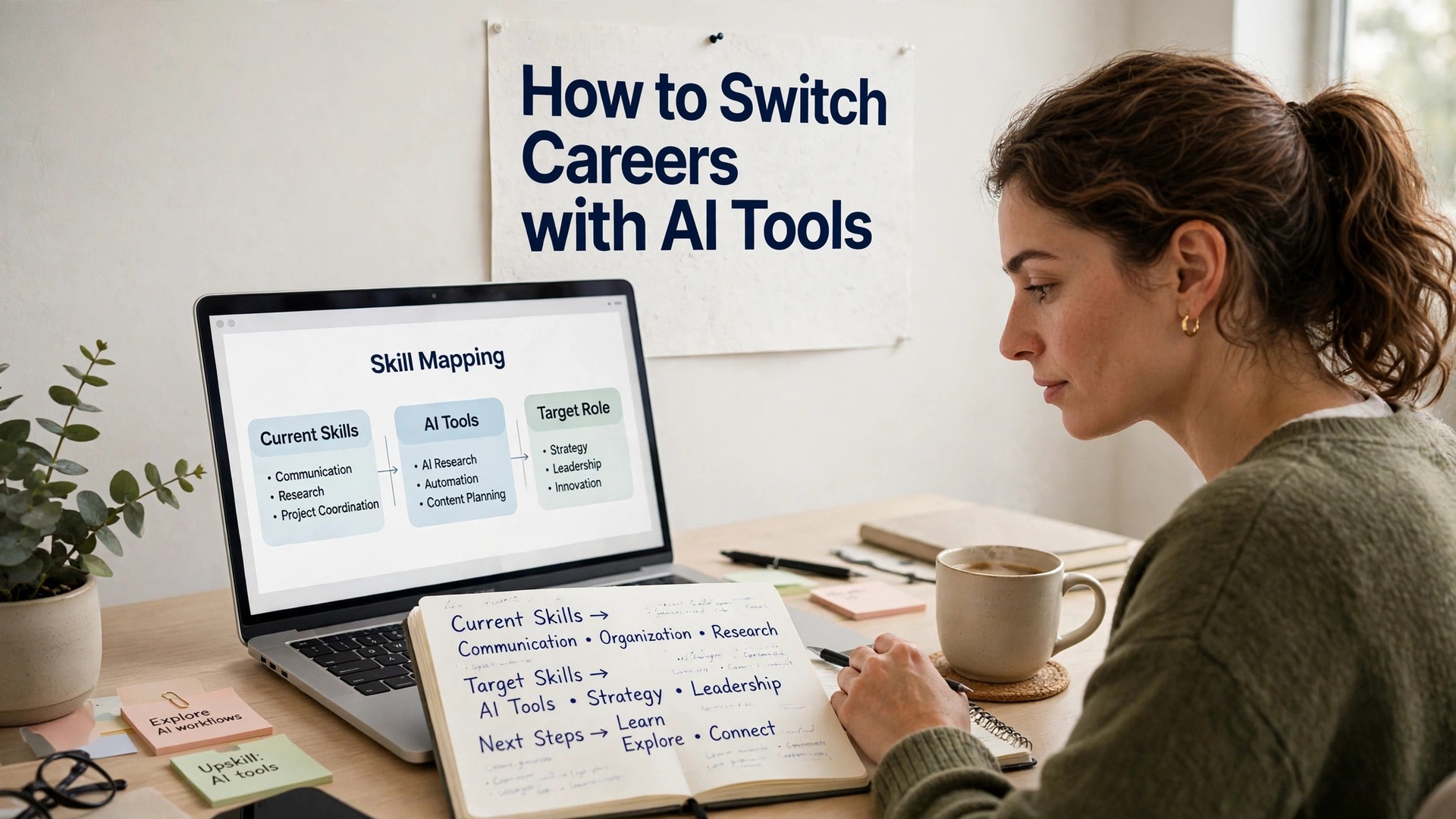
Switching careers feels like starting over, but it is not. How to switch careers with AI tools is a system for mapping what you already know onto what a new field actually wants, then proving the fit with a rewritten resume, a targeted portfolio, and a job search that aims at the right roles.
The mistake most career changers make is applying to the new field with the old resume. A hiring manager in the new field does not care what your old title was, they care whether you can do the new job, and your resume must prove that in the first ten seconds. This guide shows you the playbook, from skill mapping to the first offer.
In this article
- Quick Answer. How to Switch Careers with AI Tools in 30 Seconds
- Map Your Skills Before You Move
- Close the Gaps with Short, Proof-Backed Learning
- Rewrite Your Resume Around the New Role
- Build Proof with Two Projects
- Target Roles That Value Your Old Experience
- How to Explain a Career Change in Interviews
- Side Projects That Prove the Switch
- How to Test a New Field Before You Commit
- Money Planning for a Career Switch
- When a Career Switch Does Not Work
- Your 12-Week Career Switch Plan
- Related Guides
- Frequently Asked Questions
- The Bottom Line
Quick Answer. How to Switch Careers with AI Tools in 30 Seconds
If you want the short version, here it is. Map your transferable skills first, with ChatGPT or Claude, then close the gaps with short courses, rewrite your resume around the new role with Rezi or Teal, build proof with two projects, and target roles that value your old experience. The switch takes three to six months, not three to six years, when the plan is clear.
How to switch careers with AI tools comes down to four moves, which are map, close, prove and target. The rest of this guide shows you each move in detail, with the tools and the weekly plan.
The playbook below assumes you know the field you want to move into. If you do not, start with section one and use the mapping exercise to find the fields where your skills already fit, because the best career change is the one that builds on what you have, not the one that discards it.
| Week | Focus | Key action | Tool |
|---|---|---|---|
| 1-2 | Map skills | List transferable skills, find gaps | ChatGPT, Claude |
| 3-4 | Close gaps | Take one short course, build one project | LinkedIn Learning, Coursera |
| 5-6 | Rewrite resume | Tailor resume to new role, score it | Rezi, Teal, Jobscan |
| 7-8 | Build proof | Finish second project, publish portfolio | GitHub, Canva, LinkedIn |
| 9-10 | Target roles | Apply to 20 roles, message hiring managers | Teal, LinkedIn |
| 11-12 | Interview | Practise with mocks, negotiate offer | Yoodli, Levels.fyi |
Map Your Skills Before You Move
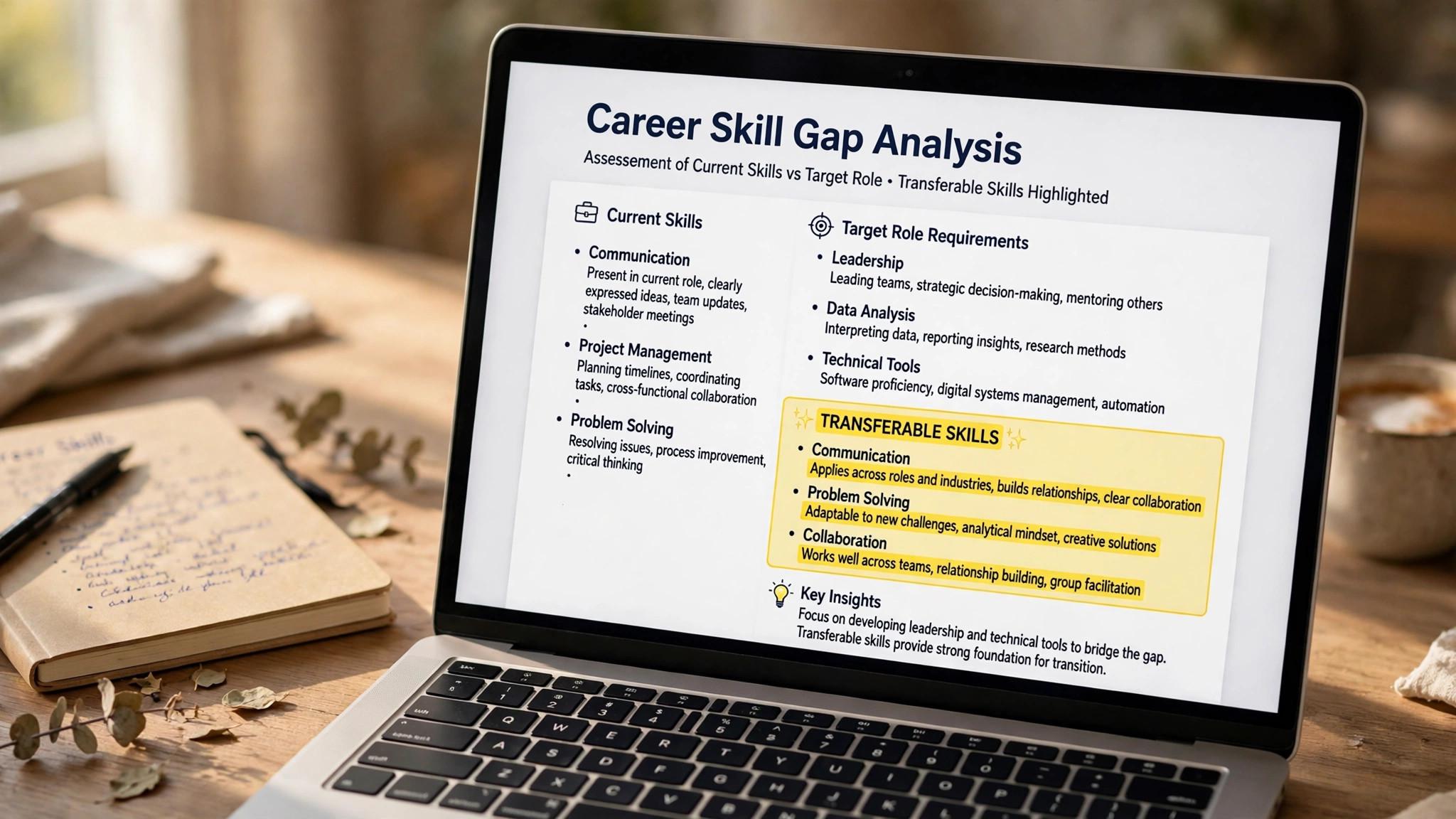
Start by listing everything you can do, not just your job title. A teacher manages classrooms, designs curriculum, communicates with parents, and handles data, which maps to training, instructional design, customer success and operations. A retail manager handles inventory, staff, budgets and customer complaints, which maps to operations, project management and customer success. Your title is the least useful fact about you, and your skills are the most useful.
Use ChatGPT or Claude to map the skills. Paste your resume and the job description for the role you want, and ask which skills transfer, which ones are missing, and what evidence you already have. The AI will find connections you missed, because it reads the posting literally, while you read your own history through the lens of your old title.
Score the gaps honestly. A gap you can close in a month, such as a tool or a certification, is not a barrier, it is a task. A gap that needs a year, such as a degree, is a barrier, and the role may not be the right target. Pick a target role where the gaps are small and closable, because the switch should take months, not years.
Talk to people in the new field before you commit. Message five people on LinkedIn who made the same switch, ask what surprised them, and listen for the gaps they wish they had closed first. A ten-minute conversation saves a month of wrong preparation, and it tells you whether the field is really what you think it is.
Write the map down. A one-page skill map, with your transferable skills, the gaps, and the plan to close them, is the brief for everything that follows. The resume, the courses, the projects and the applications all come from this page, and a switch without a map is a guess.
Close the Gaps with Short, Proof-Backed Learning
Close one gap at a time, with a course that ends in proof. A certificate alone rarely changes a hiring decision, but a certificate plus a project does, because the project proves you can do the work. Pick a course on LinkedIn Learning, Coursera or a vendor site, finish it, and build something with what you learned, in the same week.
Choose courses that employers recognise. A Google, Microsoft or AWS certificate carries weight in tech, a HubSpot or Salesforce certificate carries weight in sales and marketing, and a project management certificate carries weight in operations. A generic course from an unknown provider does not, so check what the postings in your target field actually ask for before you enrol.
Learn in public. Share what you are learning on LinkedIn, write a short post about the project, and ask questions in the community. Public learning builds a network in the new field, and it signals to recruiters that you are serious, not just curious. A career changer who learns in public gets found faster than one who learns alone.
Do not over-study. A career changer who takes six courses and builds nothing is less hireable than one who takes one course and builds two projects. Learning is the means, and proof is the end, so stop studying when you can do the work, and start proving it.
Budget the learning honestly. Most gaps close with $0 to $50 of courses and a month of evenings, and the expensive bootcamps are rarely necessary for a switch within a related field. Check the free tier first, and pay only for the course that ends in a recognised certificate or a portfolio piece.
Rewrite Your Resume Around the New Role
Rewrite the resume from scratch, around the new role, not around the old one. The summary should name the new role and the problem you solve, not your old title and your old industry. The experience section should lead with the achievements that match the new field, and the old duties should be cut or reframed, so the hiring manager sees a candidate for this job, not a candidate from another field.
Use Rezi or Teal to tailor the resume to the new role. Paste the job description, let the tool flag the missing keywords, and rewrite your bullets with the language of the new field, where it is true. A teacher who writes managed a classroom of 30 students should write designed and delivered training for groups of 30, because the second version speaks the language of the new role.
Score the rewritten resume with Jobscan free, five scans a month, and fix what it flags. A career-change resume needs a higher match rate than a normal one, because the hiring manager is already sceptical, and a low score confirms the doubt. Aim for a match rate that puts you in the top half of applicants, and do not apply until the score is there.
Add a projects section above experience, with the two projects you built while closing the gaps. The projects prove you can do the new work, and they matter more than the old job history, because they are the only evidence from the new field. Link to the work, describe the result, and let the projects carry the resume.
Keep the resume to one page, and keep the old career to a third of it. A career changer who spends a full page on the old job is telling the reader that the old job matters more than the new one, and it does not. The new role is the story, and the old career is the background.
Build Proof with Two Projects
Proof beats promises, and two projects beat ten certificates. Build the first project to learn the core skill of the new field, and build the second to solve a real problem for a real user, even a small one. A data analyst who builds a dashboard from public data and a marketer who runs a small campaign for a local business both have proof that no certificate can match.
Publish the work where hiring managers will see it. A developer publishes on GitHub, a designer on a portfolio site, a writer on a blog, and an analyst on LinkedIn with a short post explaining the project. The work should be findable, and the explanation should be clear, because a project no one can see is a project that does not exist.
Write each project as a case study, with the problem, what you did, and the result in numbers. A case study that says you built a dashboard is forgettable, and one that says you built a dashboard that cut reporting time from four hours to twenty minutes is memorable. Numbers make the proof believable, and a result makes it hireable.
Get feedback on the projects from people in the new field, before you put them on the resume. A ten-minute review from a practitioner catches the mistakes a course never mentions, and it builds a relationship with someone who might refer you. Ask for the review, listen to it, and fix what they flag.
Do not wait for permission to build. A career changer who waits for a job to prove themselves will wait forever, and one who builds proof first gets hired faster. The projects are the job, before the job exists, and they are the strongest part of a career-change application.

Target Roles That Value Your Old Experience
Target the roles where your old experience is an asset, not a liability. A teacher moving into corporate training, a nurse moving into health tech, and a retail manager moving into operations all bring domain knowledge the new field needs, and those roles hire career changers faster than roles where the old experience is irrelevant. Aim where the overlap is largest, not where the title is most exciting.
Apply to twenty roles in the first month, with a tailored resume for each, and message the hiring manager on LinkedIn for the top five. A career changer who applies silently gets filtered out, and one who reaches out with a short message about the fit gets read. The message should name the transferable skill, the project that proves it, and one question about the role.
Use your network, not just the boards. Tell everyone you know that you are switching, what you are switching to, and what you can do, because most career-change roles come through a connection, not a posting. A warm introduction from someone who knows your work beats a hundred cold applications, and the network you built in the old field is an asset, not a leftover.
Prepare for the career-change question in every interview, because it will be asked. Have a two-sentence answer ready, naming what you bring from the old field and why you are moving, without apologising for the change. A confident answer turns the question into a strength, and a defensive answer confirms the doubt.
Negotiate from the market range, not from your old salary. Check Levels.fyi, Glassdoor and Payscale for the new role, and ask for a number near the 75th percentile if your experience supports it. A career changer who accepts the first offer out of gratitude leaves money on the table, and a clear, data-backed ask signals that you understand your value in the new field.
How to Explain a Career Change in Interviews
Have a two-sentence answer ready, naming what you bring from the old field and why you are moving, without apologising for the change. A teacher who says I spent five years designing curriculum and managing classrooms, and I am moving into corporate training because I want to design learning for adults at scale has an answer that turns the change into a strength, and a candidate who apologises for the change confirms the doubt.
Lead with the transferable skill, not with the old title. A hiring manager in the new field does not care what your old title was, they care whether you can do the new job, and your answer should prove that in the first ten seconds. Name the skill, name the proof, and name the result, in that order.
Prepare for the follow-up, because the interviewer will ask why you are really leaving. Have an honest answer ready, about growth, interest, or a better fit, and avoid criticising the old field, because a candidate who criticises their last job will be expected to criticise the next one. The answer should be forward-looking, not backward-looking.
Practise the answer out loud, with Yoodli free or Google Interview Warmup, until it flows without notes. A career-change answer that sounds rehearsed is worse than one that sounds honest, and the practice is what makes it sound natural. Three sessions will fix the delivery, and the story will do the rest.
Side Projects That Prove the Switch
A side project is the strongest proof a career changer can offer, because it shows the new skill in action, not just in a course. A data analyst who builds a dashboard from public data, a marketer who runs a small campaign for a local business, and a designer who redesigns a real onboarding flow all have proof that no certificate can match, and the project is the interview before the interview.
Pick a project that solves a real problem for a real user, even a small one. A project built for yourself is practice, and a project built for someone else is proof, because the user gives you feedback, the result is measurable, and the story is believable. Ask a small business, a charity, or a friend if you can solve a problem for them, and build it.
Write the project as a case study, with the problem, what you did, and the result in numbers. A case study that says you built a dashboard is forgettable, and one that says you built a dashboard that cut reporting time from four hours to twenty minutes is memorable. Numbers make the proof believable, and a result makes it hireable.
Publish the work where hiring managers will see it, and link to it from the resume. A GitHub link, a portfolio page, or a LinkedIn post with the result all work, and the link should be in the resume, not just in the application. A project no one can see is a project that does not exist, and a project that is easy to find is a project that gets you hired.
How to Test a New Field Before You Commit
Take a short course, and see whether you enjoy the work, because a field that looks exciting from the outside can feel tedious from the inside, and a month of evenings on a real course tells you more than a year of reading about it. A course that ends in a project is the best test, because the project shows you the daily work, not just the idea of it.
Talk to five people in the field, and ask what surprised them, what they wish they had known, and what a bad day looks like. A ten-minute conversation with a practitioner tells you more than a hundred articles, because the practitioner knows the reality, and the articles know the marketing. Listen for the warnings, not just the excitement.
Do a small project for a real user, even a tiny one, because a project built for someone else tests the skill, the client, and the work, all at once. A data analyst who builds a dashboard for a local charity learns whether they enjoy the work, and a marketer who runs a small campaign learns whether they enjoy the client, and both learn more from one project than from ten courses.
Shadow someone for a day, if you can, because watching the work is different from imagining it. A day spent with a practitioner shows you the meetings, the tools, the pace, and the frustrations, and the reality is the test. A field that survives a shadow day is a field worth switching to, and one that does not is a field to skip.
Money Planning for a Career Switch
Save three to six months of expenses before you switch, because a career change takes time, and a financial cushion turns a plan into a choice, while no cushion turns it into a gamble. A switch with savings is a switch you can do properly, with courses, projects, and a patient search, and one without is a switch done in a rush, which rarely works.
Budget the switch honestly. Courses cost $0 to $50 for most gaps, projects cost time, and the job search costs three to six months of reduced income if the new role pays less at first. Add the numbers up, and save the total before you start, because a switch that runs out of money halfway is a switch that fails.
Keep the old job while you build the new one, because a switch done in the evenings, with a salary still coming in, is safer than one done after quitting. Build the proof, rewrite the resume, and apply while you are still employed, and switch when you have an offer, not before, because an offer is the proof the switch worked.
Negotiate from the market range, not from your old salary, because the new role pays the market rate, not your history. Check Levels.fyi, Glassdoor and Payscale for the new role, and ask for a number near the 75th percentile if your experience supports it, because a career changer who accepts the first offer out of gratitude leaves money on the table.
When a Career Switch Does Not Work
A switch fails when the gaps are larger than expected, and the honest response is to narrow the target, not to quit. A teacher who cannot move into data science in three months can move into corporate training in three months, and the narrower target is a switch that works, while the broader one is a dream that does not. Narrow the target, and try again, because a smaller switch is still a switch.
A switch fails when the proof is missing, and the fix is to build it, not to apply more. A career changer who applies to fifty roles with no projects and no courses will hear nothing, and one who builds two projects and then applies to twenty will hear back, because the proof is the difference, and the applications are not.
A switch fails when the network is missing, and the fix is to build it before you need it. A career changer who knows no one in the new field is applying cold, and one who knows five people is applying warm, because the introduction is the interview before the interview. Build the network first, and the roles will follow.
A switch that does not work is not a failure, it is data. The test told you the field, the timing, or the target was wrong, and the data tells you what to change. Adjust the target, close the gap, build the proof, and try again, because a switch that is adjusted is a switch that succeeds, and one that is abandoned is the only true failure.
Your 12-Week Career Switch Plan
Weeks 1-2. Map the skills. List your transferable skills, use ChatGPT or Claude to map them against the target role, and talk to five people who made the same switch. Write the one-page skill map, and pick a target role where the gaps are small and closable.
Weeks 3-6. Close the gaps and rewrite the resume. Take one short course, build the first project, and rewrite the resume around the new role with Rezi or Teal. Score it with Jobscan free, and do not apply until the match rate is strong.
Weeks 7-10. Build proof and target roles. Finish the second project, publish the work, and apply to twenty roles with tailored resumes. Message the hiring manager for the top five, and tell your network you are switching.
Weeks 11-12. Interview and negotiate. Practise with Yoodli free or Google Interview Warmup, prepare the career-change answer, and negotiate from the market range. Accept the offer that fits the plan, not the first offer that arrives.

Related Guides
- How to Use AI to Apply for Jobs Faster
- How to Write a Cover Letter with AI
- How to Write a LinkedIn Summary That Gets Recruiters
Frequently Asked Questions
How long does it take to switch careers with AI tools?
Three to six months for a switch within a related field, where the gaps are small and closable. A switch to an unrelated field can take a year or more, because the gaps are larger. AI tools shorten the mapping, the resume rewrite and the job search, but they cannot shorten the learning, so the timeline depends on the gaps, not the tools. That is the value of how to switch careers with ai tools. A tool that fits the job beats a tool that promises everything.
Can AI really help me switch careers?
Yes, for the mapping, the resume and the search. ChatGPT or Claude can map your transferable skills against a new role, Rezi or Teal can rewrite your resume in the language of the new field, and Teal can track the applications. What AI cannot do is supply the experience, so you still need the courses and the projects to prove the fit. The test for any how to switch careers with ai tools is simple. Does it fix the step where your search breaks down?
What is the best career change for a teacher?
Corporate training, instructional design, customer success and operations are the strongest moves for teachers, because they use classroom management, curriculum design and communication skills directly. The switch is faster than most, because the overlap is large, and the hiring managers in those fields value teaching experience. The right pick among how to switch careers with ai tools is the one you will actually use every week, not the one with the longest feature list.
Should I take a pay cut to switch careers?
Sometimes, and it depends on the field. A switch to a higher-paying field may mean a short-term cut for a long-term gain, and a switch to a similar-paying field should not. Check the market range for the new role on Levels.fyi or Glassdoor, and negotiate from that range, not from your old salary, so the cut is a choice, not a surprise.
Do I need a degree to switch careers?
No, for most switches, and yes, for some. Tech, marketing, operations and customer success hire on skills and proof, not degrees, and two strong projects beat a degree for those roles. Regulated fields like healthcare, law and engineering need credentials, so check the requirements in your target field before you commit to the switch.
Is it too late to switch careers at 40?
No. A career change at 40 brings twenty years of transferable skills, a network, and judgment that a younger candidate does not have, and hiring managers in many fields value that. The switch takes longer when the gaps are larger, but the experience is an asset, not a liability, and the roles that value it hire career changers faster than those that do not. That is the value of how to switch careers with ai tools. A tool that fits the job beats a tool that promises everything.
The Bottom Line
Map your transferable skills first, close the gaps with short courses and proof, rewrite your resume around the new role, and target the roles where your old experience is an asset. How to switch careers with AI tools is a system for proving the fit, and the switch takes three to six months when the plan is clear and the proof is real. Start with the free tier, and let how to switch careers with ai tools prove itself on one real role before you pay.
Start this week with the skill map. List what you can do, map it against the role you want, and talk to one person who made the switch. The map is the brief for everything that follows, and a switch with a map is a plan, not a leap. Used well, how to switch careers with ai tools saves hours every week, and the time saved is the real return on the price.
1 thought on “How to Switch Careers with AI Tools”