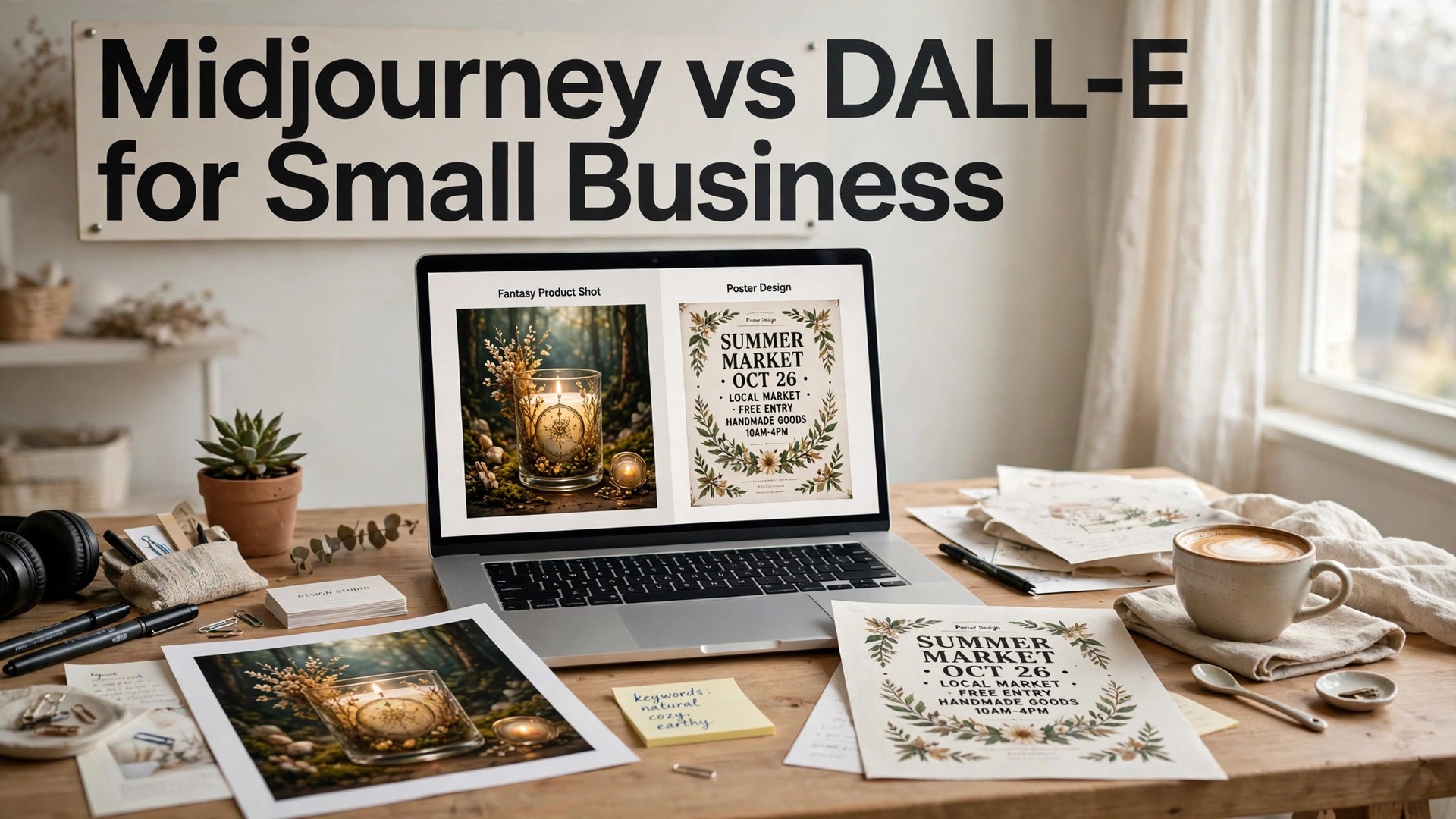
Midjourney vs DALL-E for small business comes down to one question, and it is not which tool makes a prettier picture. It is what the image is for. Midjourney wins when the image has to look beautiful, because its V8 model produces the most polished marketing images in this comparison. DALL-E, now succeeded by ChatGPT Images, wins when the image has to carry words, because it renders text inside an image better than any rival. A small business that needs a hero image and a poster with a headline will use both, and the smart move is to pick a main generator for the image you make most often, not to pay for both at once.
AI images have moved from a novelty to a working tool in two years. A shop can now make a product photo, a seasonal banner and a social post without a camera, a studio or a designer, and the results are good enough to publish. The catch is the detail. Hands, text, logos and brand colors are still the places where AI images fail, and a business that publishes a broken image loses more trust than it gains in speed. The tools in this guide are ranked on the quality a customer actually sees, not on the demo.
The trap is the name. DALL-E 3 was retired from the OpenAI API on May 12, 2026, and OpenAI now positions its GPT Image models as the current generators, inside ChatGPT on every plan. A guide that talks about DALL-E as if it were still sold separately is out of date, and a business that builds a workflow on the old API will find it gone. This guide compares Midjourney against the image generation a small business actually buys in 2026, which is ChatGPT Images, the successor to DALL-E 3, included in ChatGPT Plus at $20 a month.
The two tools look similar on a pricing page, and they are not similar in use. Midjourney is an image tool that lives in a browser and on Discord, with a community gallery, styles and a prompt system built for beauty. ChatGPT Images is a chat tool that makes images, with conversational editing, text rendering and a workflow built for speed. A business that understands that difference will pick the right tool in a day, and a business that does not will pay for both and use neither well.
Quick Answer. Midjourney vs DALL-E in 30 Seconds
If you want the short version, here it is. Midjourney is the best pick for beautiful marketing images, with Standard at $30 a month and unlimited relaxed images. ChatGPT Images, the successor to DALL-E 3, is the best pick for images with text, included in ChatGPT Plus at $20 a month. A business that makes hero images should pay for Midjourney Standard. A business that makes posters, menus and sale signs should pay for ChatGPT Plus. A business that makes both should use Midjourney for the hero image and ChatGPT Images for the poster.
The midjourney vs dall-e for small business decision is really a decision about the image you make most often. The table below compares the two on the facts that change a decision, and the sections after it test each one on image quality, text, styles, pricing, ease of use and commercial safety.
| Feature | Midjourney | DALL-E / ChatGPT Images |
|---|---|---|
| Best for | Beautiful marketing images | Images with text |
| Free tier | No free plan | Free with daily limits |
| Paid from | $10/mo Basic | $20/mo ChatGPT Plus |
| Image quality | Best here | Good, less polished |
| Text rendering | Weak | Best here |
| Styles | Community styles | Conversational prompts |
| Commercial use | Paid plans, Pro for $1M+ revenue | Included on paid plans |
| Access | Browser and Discord | ChatGPT app and web |
| Learning curve | Moderate | Easiest here |
Image Quality. Midjourney Wins by a Wide Margin
The first test is image quality, and Midjourney wins it by a wide margin. Its V8 model produces images with a polish that no rival matches, from product shots to lifestyle photos to illustrations, and its community gallery is a library of styles you can copy and adapt. A Midjourney image looks like a photograph or an illustration made by a professional, with light, color and composition that hold up at full size. A ChatGPT Images picture looks good, but it looks like an AI image, with a smoothness and a symmetry that gives it away on a second look.
The quality gap shows up in the details. Midjourney handles skin, fabric, metal and glass with a realism that ChatGPT Images cannot match, and its upscaling keeps the detail sharp at print size. ChatGPT Images handles a simple scene well, but a complex scene with several objects, a specific light and a brand color will come back simpler than the prompt asked for. A business that needs a hero image for a website, a catalogue cover or a large print should use Midjourney, because the image will be seen at full size and the quality will show.
The gap narrows on small images. A social post at 1080 pixels wide hides the difference, because the viewer sees the image for two seconds on a phone. A hero image at full width shows the difference, because the viewer sees the image for longer and at a larger size. A business that makes social posts will not feel the gap. A business that makes website heroes and print will feel it every time.
Text Rendering. ChatGPT Images Wins by a Wide Margin
The second test is text, and ChatGPT Images wins it by a wide margin. It renders words inside an image more accurately than any rival, which matters for posters, menus, sale signs, book covers and social posts with a headline. A poster that says 20 percent off this weekend will come back with the words spelled right, in a readable font, in the right place. A Midjourney poster with the same prompt will come back with garbled letters, missing words or a font that looks wrong, because Midjourney was never built to render text.
The text gap is the reason many businesses use both tools. They make the hero image in Midjourney, then add the headline in Canva, or they make the whole poster in ChatGPT Images and skip the design step. A business that makes posters, menus and sale signs should use ChatGPT Images, because the text is the message and a garbled headline loses the sale. A business that makes hero images should use Midjourney, because the image is the message and the text can be added later in a design tool.
The gap is closing slowly, because Midjourney improves its text rendering with every model, but in 2026 the difference is still large enough to decide the tool. A business that needs text in the image should not wait for Midjourney to catch up. It should use ChatGPT Images today, and use Midjourney for the images that carry no words.
Styles. Midjourney Wins on Range, ChatGPT Wins on Conversation
The third test is styles, and the result is a split. Midjourney wins on range, with a community gallery of thousands of styles, from photography to illustration to 3D renders, and with parameters that control the aspect ratio, the chaos, the stylisation and the version. A user who learns the parameters can make the same prompt look like a photograph, a watercolor or a product render, and the community styles save hours of prompt writing. The style system is the deepest here, and it rewards a user who invests time in learning it.
ChatGPT Images wins on conversation, because the editor is a chat. You describe the image in plain words, and the model asks a question or makes a change when you ask for it in plain words. There is no parameter to learn, no gallery to browse, and no prompt syntax to memorise. A user who writes a short prompt gets a good image, and a user who writes a long prompt gets a better one, but the skill is writing, not prompting.
A business that wants a consistent style should use Midjourney, because its parameters and community styles make consistency possible. A business that wants a quick image should use ChatGPT Images, because the chat is faster than the gallery. That split is the heart of the midjourney vs dall-e for small business choice.
Pricing. ChatGPT Plus Is Cheaper, Midjourney Standard Is Fair
The fourth test is pricing, and ChatGPT Plus is cheaper. ChatGPT Plus costs $20 a month and includes image generation with higher limits, about 50 generations every three hours, plus all other Plus features, from writing to analysis to browsing. The free plan includes image generation with daily limits, which suits testing. ChatGPT Pro costs $100 a month and adds faster, unlimited image creation. There is no per-image fee for in-app generation on Plus, which makes the price simple to understand.
Midjourney costs $10 a month on Basic, $30 on Standard, $60 on Pro and $120 on Mega, with 20 percent off on annual billing. Basic buys 3.3 hours of fast GPU time, with no relaxed mode. Standard buys 15 hours plus unlimited relaxed images, which is the tier most small businesses should pick. Pro buys 30 hours, unlimited relaxed images and video, and Stealth mode, which keeps your images private. Mega buys 60 hours. There is no free plan, so the cheapest test costs $10, and companies with more than $1 million in yearly revenue must use Pro or Mega for commercial work.
The price gap is $10 a month between ChatGPT Plus and Midjourney Standard, and the value gap depends on the job. A business that makes posters and menus gets more from ChatGPT Plus at $20 a month, because it also buys the rest of ChatGPT. A business that makes hero images gets more from Midjourney Standard at $30 a month, because the image quality is the best here. Check the price at checkout, because both tools change their prices often.
Ease of Use. ChatGPT Images Is Easier, Midjourney Is Deeper
The fifth test is ease of use, and ChatGPT Images is easier. The editor is a chat, so you describe the image in plain words, and the model makes it. There is no Discord server to join, no parameter to learn, and no gallery to browse. A first image takes a minute, and a first-time user can make a good poster in ten minutes. The conversational editing is the easiest way to fix an image, because you ask for the change in plain words and the model makes it.
Midjourney is deeper, with a browser editor and a Discord server, a parameter system, a community gallery and a prompt syntax that rewards learning. A first image takes longer, because the user has to learn the interface, the parameters and the style system, but the payoff is control.
A user who learns Midjourney can make the same prompt look like a photograph, a watercolor or a product render, and the consistency is worth the learning curve for a business that makes images every week. A business that makes one image a week will find ChatGPT Images faster. A business that makes ten images a week will find Midjourney faster, because the style system saves time once it is learned.
Commercial Safety. A Tie on Paid Plans, Firefly Wins Overall
The sixth test is commercial safety, and it is a tie on paid plans, with a note that neither tool is the safest overall. Midjourney grants commercial rights on paid plans, with companies over $1 million in yearly revenue required to use Pro or Mega, and with Stealth mode on Pro keeping your images private. ChatGPT Images grants commercial rights on paid plans too, with the terms in OpenAI’s terms of service, and with no Stealth mode, so your images are not private by default. Both tools are safe enough for a small business that publishes images commercially, as long as the plan is paid.
The note is that Adobe Firefly is safer than both, because it was trained on licensed Adobe Stock and public domain content, and Adobe offers an indemnity for commercial use on paid plans. A business that worries about training data should use Firefly at $9.99 a month for the images that carry legal risk, and use Midjourney or ChatGPT Images for the rest. Read the licence before you publish, because a free plan often limits commercial use, and the terms change often.
The Free Plan Test. Midjourney vs DALL-E Without Paying
The free plans are where the midjourney vs dall-e for small business decision often gets made, because the gap between them is large. ChatGPT Images is free with daily limits, which suits testing and a few images a week. The free plan includes image generation on every plan, with higher limits on Plus, and with no per-image fee for in-app generation. A business that cannot pay yet can still make a poster, a menu or a social post in ChatGPT, publish it, and build an audience, with no watermark telling the viewer the tool was unpaid.
Midjourney has no free plan at all, so the cheapest test costs $10 a month on Basic. Basic buys 3.3 hours of fast GPU time, with no relaxed mode, which means the fast hours run out quickly for a business that generates daily. The lack of a free plan is the biggest barrier to Midjourney for a small business, and it is the reason many businesses start with ChatGPT Images and add Midjourney later, when the image habit is working and the budget is clear.
The third test is what the paid plan adds. ChatGPT Plus at $20 a month adds higher image limits, about 50 generations every three hours, plus all other Plus features. Midjourney Standard at $30 a month adds 15 hours of fast GPU time plus unlimited relaxed images, which removes the worry about running out. Both paid plans are fair for what they cover, and the choice depends on the job, not the price.
1. Midjourney. Best for Beautiful Marketing Images
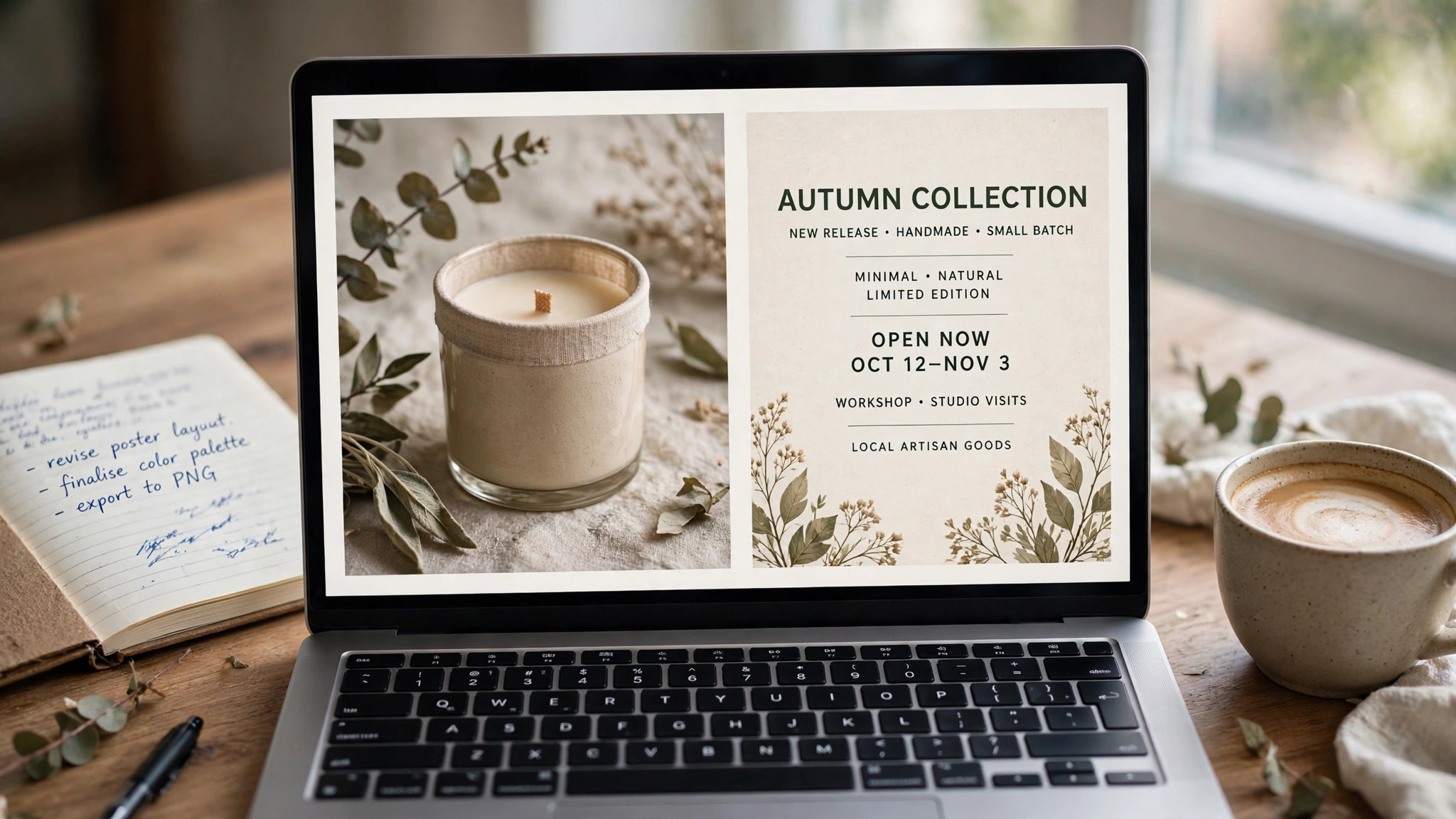
Midjourney is the strongest choice in the midjourney vs dall-e for small business comparison when the image itself is the priority. Its V8 model produces images with a polish that no rival matches, from product shots to lifestyle photos to illustrations, and its community gallery is a library of styles you can copy and adapt. The editor runs in a browser and on Discord, with upscaling, variation and editing tools built in, and the style system rewards a user who invests time in learning it.
Pricing has no free plan. Basic costs $10 a month and buys 3.3 hours of fast GPU time. Standard costs $30 a month and buys 15 hours plus unlimited relaxed images. Pro costs $60 a month and buys 30 hours, unlimited relaxed images and video, and Stealth mode. Mega costs $120 a month and buys 60 hours. Annual billing takes 20 percent off every tier. Companies with more than $1 million in yearly revenue must use Pro or Mega for commercial work.
Midjourney’s style system is the feature that sets it apart for a business that needs a consistent look. The parameters control the aspect ratio, the chaos, the stylisation and the version, and the community gallery lets you copy a style that already works. A business that makes a dozen images a month will feel the saving in the time it takes to start each one, because the style, the colors and the composition are already decided.
What works. The image quality is the best here, and Standard at $30 a month is the right tier for most small businesses, because unlimited relaxed images remove the worry about running out. The community styles save hours of prompt writing.
What to watch. There is no free plan, so the cheapest test costs $10. Basic has no relaxed mode, so the fast hours run out quickly, and the text rendering is weak, so a poster with words will need a second tool.
2. ChatGPT Images. Best for Images with Text
ChatGPT Images, the successor to DALL-E 3, is the strongest choice in this comparison when the image has to carry words. It renders text inside an image more accurately than any rival, which matters for posters, menus, sale signs, book covers and social posts with a headline. The editor is conversational, so you can ask for changes in plain words, and the image model now sits inside ChatGPT on every plan, with higher limits on paid plans. DALL-E 3 was retired from the OpenAI API in May 2026, and the GPT Image models replaced it, so new projects should use the ChatGPT app or the GPT Image API.
Pricing starts free with daily limits. ChatGPT Plus costs $20 a month and raises the image limits to about 50 generations every three hours, plus all other Plus features. ChatGPT Pro costs $100 a month and adds faster, unlimited image creation. There is no per-image fee for in-app generation on Plus, which makes the price simple to understand. The free plan suits testing, and Plus suits a business that makes images weekly.
ChatGPT Images is also the easiest tool here to learn, because the editor is a chat. You describe the image in plain words, and the model makes it, with no parameter to learn and no gallery to browse. A business that makes a poster in the morning and a menu in the afternoon will find the chat faster than any other workflow, because the skill is writing, not prompting.
What works. The text rendering is the best here, and the conversational editing is the easiest way to fix an image without learning a new tool. Plus at $20 a month also buys the rest of ChatGPT, which is good value.
What to watch. The image style is less polished than Midjourney for pure photography, and the free plan is limited. The API pricing is token-based, so check the current rate before you build a workflow on it.
Which Images Each Tool Handles Best
The midjourney vs dall-e for small business choice becomes clear when you sort images by type. A hero image for a website belongs in Midjourney, because the image quality is the best here and the hero will be seen at full size. A product shot for a catalogue belongs in Midjourney too, because the detail holds up at print size. A lifestyle photo for a social post belongs in Midjourney, because the light and color look professional.
A poster with a headline belongs in ChatGPT Images, because the text rendering is the best here and a garbled headline loses the sale. A menu belongs in ChatGPT Images, because the prices and dish names have to be spelled right. A sale sign belongs in ChatGPT Images, because the discount and the date have to be readable at a glance. A book cover with a title belongs in ChatGPT Images, because the title is the message.
The pattern is simple. An image that carries no words belongs in Midjourney. An image that carries words belongs in ChatGPT Images. A business that makes both kinds should use both tools, with Midjourney Standard for the hero images and ChatGPT Plus for the posters, and pay for the second tool only when the volume justifies it.
Midjourney vs DALL-E for Small Business. The Verdict by Job
Start with the image you make most often, not the tool. A business that makes hero images should pay for Midjourney Standard at $30 a month. A business that makes posters, menus and sale signs should pay for ChatGPT Plus at $20 a month. A business that makes both should use Midjourney for the hero image and ChatGPT Images for the poster, and pay for the second tool only when the volume justifies it.
Step 1. Count the images. Write down how many images you make each week, and how many of them carry words and how many do not. A business that makes five hero images a week needs Midjourney. A business that makes five posters a week needs ChatGPT Images.
Step 2. Test both. Open ChatGPT free and Midjourney Basic at $10 a month, and generate the same prompt in both. Compare the results side by side at full size, and check the image quality, the text and the time it took. A tool that looks good in a demo may not look good in your brand colors.
Step 3. Check the text. If the image has words, generate it in ChatGPT Images and check the spelling, the font and the placement. If the image has no words, generate it in Midjourney and check the detail at full size.
Step 4. Check the licence. Read the commercial terms before you publish, because a free plan often limits commercial use. Midjourney grants commercial rights on paid plans, with companies over $1 million in yearly revenue required to use Pro or Mega. ChatGPT Images grants commercial rights on paid plans too.
Step 5. Pay for one. Pick the tool that fits the image you make most often, and pay for that one only. A second subscription should wait until the volume justifies it, because two tools that overlap cost more than one tool that fits.
Related Guides
Frequently Asked Questions
Is Midjourney or DALL-E better for small business?
It depends on the image. Midjourney is better for beautiful marketing images, because its V8 model produces the most polished results in this comparison. ChatGPT Images, the successor to DALL-E 3, is better for images with text, because it renders words inside an image more accurately than any rival. Most small businesses should use Midjourney for hero images and ChatGPT Images for posters, menus and sale signs.
Is DALL-E still available in 2026?
DALL-E 3 was retired from the OpenAI API on May 12, 2026, and OpenAI now positions its GPT Image models as the current generators, inside ChatGPT on every plan. You can still create images in ChatGPT, free with daily limits, or without per-image charges on ChatGPT Plus at $20 a month. New projects should use ChatGPT Images or the GPT Image API, not the old DALL-E API.
How much does Midjourney cost?
Midjourney costs $10 a month on Basic, $30 on Standard, $60 on Pro and $120 on Mega, with 20 percent off on annual billing. There is no free plan, so the cheapest test costs $10. Standard at $30 a month is the right tier for most small businesses, because it adds 15 hours of fast GPU time plus unlimited relaxed images. Companies with more than $1 million in yearly revenue must use Pro or Mega for commercial work.
Can I use AI images commercially?
Yes, on most paid plans, but read the licence first. Midjourney grants commercial rights on paid plans, with companies over $1 million in yearly revenue required to use Pro or Mega. ChatGPT Images grants commercial rights on paid plans too. Adobe Firefly is the safest here, because it was trained on licensed stock and Adobe offers an indemnity for commercial use on paid plans. A free plan often limits commercial use, so check the terms before you publish.
Which tool should a beginner start with?
ChatGPT Images is the better start for a beginner, because its editor is a chat, its free plan covers daily limits, and its text rendering is the best here. A first image takes a minute, and a first-time user can make a good poster in ten minutes. Midjourney is the better second tool, because its image quality and style system are worth learning once the image habit is working, and its Standard plan at $30 a month is the right upgrade when hero images become daily work.
The Bottom Line
Midjourney vs DALL-E for small business comes down to the image you make most often. Midjourney is the best choice for beautiful marketing images, with Standard at $30 a month and unlimited relaxed images. ChatGPT Images, the successor to DALL-E 3, is the best choice for images with text, included in ChatGPT Plus at $20 a month.
A business that makes hero images should pay for Midjourney Standard. A business that makes posters, menus and sale signs should pay for ChatGPT Plus. Start with ChatGPT free and Midjourney Basic at $10 a month, test the same prompt in both, and pay only for the one that fits the image you make most often.
1 thought on “Midjourney vs DALL-E for Small Business”