
The Top 10 Programmatic SEO Tools for most content teams start with Byword, because it turns a keyword list into finished articles at scale, with research, internal linking and one click publishing, from 99 dollars a month. Programmatic SEO is the discipline of publishing hundreds of similar pages from one template, and the tool that does the writing and the publishing in one pass wins. The fifteen tools below cover writing, optimisation, crawling and the publishing end of the system.
A team that publishes one page at a time will never cover a thousand keywords. The math is simple, and it is brutal, because a writer who ships two pages a week needs ten years to cover a thousand topics. Programmatic SEO breaks that math by building one strong template, feeding it clean data, and publishing pages that differ in the facts rather than in the shape.
This guide compares fifteen tools on volume, quality control, publishing and price, with a clear pick for a team starting out and a clear pick for a team already publishing at scale. Every price comes from the vendor own page or a published review of it, and the verdict at the end names the setup a team can run this month.
Quick jump
- The 15 Tools at a Glance
- Best Pick by Job
- Which Top 10 Programmatic SEO Tools Publish Pages That Actually Rank?
- How to Choose the Right Programmatic SEO Setup
- The 15 Tools in Detail
- Byword vs Koala, Which One Writes Bulk Pages Better?
- Can AI Writers Replace Human Editors at Scale?
- What Does Programmatic SEO Cost in 2026?
- Frequently Asked Questions
- The Final Word on Programmatic SEO
The 15 Tools at a Glance
| Tool | Main job | Best for | Starting price |
|---|---|---|---|
| Byword | Bulk article generator | teams that need dozens of article style pages fast | from $99/mo |
| AirOps | AI content workflow builder | teams with a defined process they want to automate | Free tier; paid reported from $199/mo |
| Jasper | AI marketing platform | marketing teams that publish a lot of on brand copy | from $59/seat/mo (billed annually) |
| Frase | Content research and optimisation | writers who want a research led brief before they type | reported from $39/mo |
| Surfer | Content optimisation platform | teams that write a lot and want every page scored before it ships | from $49/mo (billed annually) |
| Writesonic | AI writing and SEO platform | small teams that want one tool for writing and seo | from $79/mo |
| Brandwell | Content and SEO platform | content teams that publish long articles every week | from $249/mo |
| Koala | AI article writer | affiliate and blog teams that need long drafts cheap | from $25/mo |
| Clearscope | Content optimisation platform | teams that optimise high value pages one by one | from $129/mo |
| NeuronWriter | Content optimisation with NLP | writers who optimise by the numbers | from $23/mo |
| Screaming Frog | Website crawler | anyone who audits sites before publishing at scale | Free; paid licence $279/year |
| Ahrefs | SEO suite with backlink index | teams that judge seo by links and content gaps | from $129/mo |
| Semrush | All in one SEO suite | teams that want one suite for classic seo and ai search in the same login | from $139.95/mo |
| Rank Math | WordPress SEO plugin | wordpress sites that want a free plugin with room to grow | Free; Pro from $6.99/mo |
| WordPress | Publishing platform | every team in this list that publishes on wordpress | Free (self-hosted software) |
Best Pick by Job
| Job type | First pick | Second tool | Why this pair works |
|---|---|---|---|
| Most pages per month | Byword | Koala | Byword plans by article count, Koala is cheaper per long page |
| Best page quality scores | Surfer | Clearscope | Surfer guides the draft live, Clearscope grades most strictly |
| Best custom workflow | AirOps | Jasper | AirOps builds any workflow, Jasper keeps brand voice steady |
| Cheapest way to start | Koala | NeuronWriter | Koala starts low per word, NeuronWriter adds cheap optimisation |
| Best pre publish check | Screaming Frog | Rank Math | Screaming Frog crawls the batch, Rank Math handles on page basics |
The Top 10 Programmatic SEO Tools in this guide split into writers, optimisers and checkers, and a working system needs one of each. Byword, Jasper and Koala write the pages, Surfer, Frase and Clearscope score them, and Screaming Frog checks the site before the batch goes live. A team that buys only a writer will publish fast and rank slowly, because unoptimised pages do not survive the first crawl.
Which Top 10 Programmatic SEO Tools Publish Pages That Actually Rank?
Template quality decides the ranking, and no writer can save a weak template. A page that answers the search question with real data, clear headings and internal links will rank, while a page that swaps one keyword into a thin paragraph will not. Surfer and Clearscope earn their place here, because they score each page against the pages already ranking before it ships.
Data quality comes next. Programmatic pages live or die by the data behind them, so a template fed with clean prices, dates and specs will beat a template fed with scraped guesses. AirOps earns its place here, because its workflows let a team check and clean the data before the writing step runs.
How to Choose the Right Programmatic SEO Setup
Start with the template, because the tool follows the template rather than the other way round. Sketch one page by hand, check that it answers the search question fully, and only then pick a tool that can build a thousand versions of it. The Top 10 Programmatic SEO Tools all assume a good template, and a team that skips this step will publish a thousand weak pages instead of a hundred strong ones.
Next, count the real volume. A team that needs twenty pages a month should buy a cheap writer and spend the saving on editing, while a team that needs five hundred pages a month should buy a volume tool and build a quality check into the workflow. The price per page falls as volume rises, and the editing cost rises with it, so the budget must cover both.
The 15 Tools in Detail
The fifteen tools below run from bulk writers to optimisers to the crawlers and plugins that finish the system. Each entry states the starting price, the main job and who it fits, so the Top 10 Programmatic SEO Tools can be compared on the same terms.
1. Byword
Byword turns a keyword list into finished SEO articles at scale, with research, internal linking and one click publishing to WordPress and other platforms. Published pricing starts from $99/mo.
Its volume is the point, with plans sized by article count rather than seats.
Bulk output still needs a human edit, and small volumes cost more per article. Suits teams that need dozens of article style pages fast.
Bulk pages drift fast, so the weekly check is the published batch itself. Every Monday, pick five pages the tool published last week, check their rankings and read two of them end to end, and write the findings in a shared sheet. A team that publishes hundreds of pages and never re-reads them will find the thin ones only when traffic falls, while a weekly sample shows the quality slide in time to tighten the brief. Volume without a weekly sample is just pages.
Byword’s plans are sized by article count, so the trial should run on a real keyword list: twenty-five articles in, does the batch read well enough to publish without a rewrite?
2. AirOps
AirOps lets a team build custom content workflows from playbooks that link research, writing, publishing and analytics in one chain. Published pricing starts at Free tier; paid reported from $199/mo.
Its workflows are the most flexible here, so a team can automate its own process rather than adopt a template.
It is a kit more than a writer, so a team must design the workflow first. Suits teams with a defined process they want to automate.
AirOps is a kit, so the trial has to run on a real workflow, not a sample playbook. Build one chain the team already runs by hand, from research to publishing, and let AirOps run it for a week on live keywords. If the chain saves hours without losing quality, the kit earns its keep, while a chain that only adds steps is not worth automating. AirOps is a kit, so the trial has to prove the chain saves hours: build it, run it on live keywords for a week, and decide on that week alone.
AirOps is a kit, not a writer, so the trial should automate one chain the team already runs by hand and see whether it saves hours without losing quality.
3. Jasper
Jasper writes on brand marketing copy with brand voices, a knowledge base and a Canvas editor, and it now covers campaigns as well as single pages. Published pricing starts from $59/seat/mo (billed annually).
Its brand voice control keeps bulk output sounding like one company.
It is priced per seat, so a large team pays more, and it does no rank tracking. Suits marketing teams that publish a lot of on brand copy.
Jasper is priced per seat, so the report has to justify every seat to the person who pays. During the trial week, pull one campaign report, hand it to the budget holder, and see whether it shows what the copy achieved without a meeting. If the report needs a meeting to explain, the seats will not survive the first quarter, however on brand the copy sounds. Put the report in front of the budget holder first, because the renewal is their call.
Jasper charges per seat, so the trial should run on one real campaign and ask the budget holder whether the on-brand copy is worth a seat each.
4. Frase
Frase researches the top ranking pages for a topic, builds a brief from them and scores a draft as it is written. Published pricing starts at reported from $39/mo.
Its briefs save hours of research, and the score keeps writers on topic.
It optimises single pages rather than publishing at scale. Suits writers who want a research led brief before they type.
Frase briefs live in the export, so test whether the brief survives outside the tool. During the trial, export one brief and one scored draft, open both in a spreadsheet, and check whether a writer who has never opened Frase could work from them. If the research behind the brief is locked to a higher tier, the cost of keeping old briefs climbs later. A brief that a freelance writer can follow unaided is worth more than a clever score.
Build one brief from a real topic in Frase, write the draft to its score, and see whether the brief saved research time.
5. Surfer
Surfer holds a draft up against the pages winning the ranking now, then steers the headings, wording and shape until the score passes the mark. Published pricing starts from $49/mo (billed annually).
Surfer’s content editor is the handiest in this guide, and its score hands writers a number to aim at.
Surfer grades pages instead of drafting them, and heavy users run into the credit limit. It suits teams that write heavily and want each page scored before it goes out.
Scores drift as the ranking pages change, so the weekly check is the score itself. Every Friday, rescore the same five pages, note which terms the tool now asks for, and write the scores in a shared sheet. A page scored once and forgotten will fall behind while the team thinks it is finished, while a weekly rescore shows the drift in time to update the page. The score only helps when someone watches it move.
Surfer sells credits, so the trial should score five live drafts and watch whether the score moves when the headings and terms change.
6. Writesonic
Writesonic combines AI article writing with SEO checks and an AI visibility add on, so a team can draft and optimise in one account. Published pricing starts from $79/mo.
It covers writing, optimisation and AI tracking in one subscription.
Its depth in each job is thinner than a specialist tool. Suits small teams that want one tool for writing and SEO.
Writesonic does three jobs in one account, so the trial has to test all three on live work. Draft one real article, run the SEO checks on it, and switch on the AI visibility add on for the same week, then judge whether any of the three changed a decision. A tool that writes fast but optimises thin is not earning its fee, while one useful surprise in any of the three jobs is worth keeping. Mark the trial end date in the calendar on day one, so the choice is made on that week, not on the feature list.
Writesonic does three jobs in one account, so the trial week should test all three on one real article and judge whether any of them changed a decision.
7. Brandwell
Brandwell, formerly Content at Scale, writes long form SEO content through its RankWell product and checks it for quality before it ships. Published pricing starts from $249/mo.
Its long form output is built for ranking, with a full editorial workflow behind it.
Its entry price is high for a small team, and the workflow takes learning. Suits content teams that publish long articles every week.
At 249 dollars a month the report has to justify the price to the person who signs. Export one RankWell report during the trial, send it to the manager, and ask whether it shows the quality checks plainly enough to trust. If the report needs a walkthrough, a content team will not keep paying for it, however long the articles are. The reporting test should happen before the first invoice, not after the first quarter.
At 249 dollars a month, Brandwell’s trial should run on the long articles the team actually ships, and the RankWell report has to justify the price to the person who signs.
8. Koala
KoalaWriter writes long articles from a keyword using live search results, with internal linking, AI images and one click publishing to WordPress, Shopify, Webflow and Ghost. Published pricing starts from $25/mo for the Starter plan, with 45,000 words a month.
It is the cheapest long form writer here, and the SERP aware drafts need less fixing.
Pricing is by words, so premium models burn the allowance faster. Suits affiliate and blog teams that need long drafts cheap.
Koala charges by the word, so the export has to show what those words bought. During the trial, pull a report of the articles written, open it in a spreadsheet, and check whether the word counts, costs and publishing status all line up. If older months sit behind a higher tier, the price of looking back climbs just when the team wants to prove the spend. A clear export that ties words to published pages is the proof an affiliate team needs at renewal.
Spend part of the 45,000-word Starter allowance on one real article and check how much editing the draft still needs.
9. Clearscope
Clearscope grades a draft against the top ranking pages and lists the terms and headings a page needs to compete. Published pricing starts from $129/mo.
Its grading is the most trusted here, and the reports are easy to share with writers.
It is a single job tool at a premium price, with no writing or tracking. Suits teams that optimise high value pages one by one.
Clearscope grades one page at a time, so the weekly check is the grade on the pages that matter most. Every Monday, regrade the same five high value pages, note which terms the tool now wants, and write the grades in a shared sheet. A page graded once and left alone will slip while the team thinks it is done, while a weekly grade shows the slip in time to rewrite. Premium grading only pays when someone watches the grades move.
Clearscope grades one page at a time at a premium price, so the trial should grade the five highest-value pages and see whether the term lists point at real fixes.
10. NeuronWriter
NeuronWriter analyses top ranking pages with NLP, then guides a writer with term suggestions, content scores and an AI writer inside the editor. Published pricing starts from $23/mo.
Its NLP term list is detailed, and the price is low for the depth.
The interface is dense, and it does no rank tracking or publishing. Suits writers who optimise by the numbers.
NeuronWriter is cheap, but the trial still has to run on real pages. Load five live pages, follow the term suggestions for a week, and watch whether the content scores move and the rankings follow. A dense interface is fine if the scores point at real fixes, while scores that only shuffle terms are not worth the time. NeuronWriter’s trial is a week of live pages, so put the decision date in the calendar on day one and judge the scores only after that week of work.
NeuronWriter is cheap, so the trial is not about the price: load five live pages, follow the term suggestions for a week, and see whether the scores point at real fixes.
11. Screaming Frog
Screaming Frog crawls a site the way a search engine does, finding broken links, duplicate pages, missing tags and redirect chains. Published pricing starts at Free; paid licence $279/year.
Its crawl data is the most complete here, and the free version covers small sites.
It finds problems rather than fixing them, and big crawls need a fast machine. Suits anyone who audits sites before publishing at scale.
Screaming Frog finds problems rather than fixing them, so the trial should crawl one live site and count how many broken links and duplicates it surfaces in an hour.
12. Ahrefs
Ahrefs earns its place here on link data: the live backlink index behind it runs deep. The same login opens Site Explorer, Keywords Explorer, Site Audit, Rank Tracker and Brand Radar for AI mentions. Published pricing starts from $129/mo.
On link data and content gaps it leads the whole guide, and even a large site under audit loads its reports without lag.
On the entry plan a team can follow only so many keywords, and the AI features are held back for the dearer tiers. Link data and content gaps are the reason to buy Ahrefs, so a team that lives by those two numbers will feel at home here.
Open Site Explorer on the site’s own top pages and check whether the content gaps it flags are worth the 129 dollars a month.
13. Semrush
Semrush gives a content team the full SEO job in a single account, with search-term research, page audits, rank checks, link data and the content tools. The AI Visibility Toolkit watches which prompts on ChatGPT, Perplexity and Google AI answers mention the brand, and the team can see the answer beside the classic ranking in the same login. Published pricing starts from $139.95/mo.
Semrush’s database spans further than any other tool in this guide, so keyword, rival and AI visibility work all fit under one subscription.
The monthly total climbs steeply once seats or extra toolkits join the plan, and a newcomer can get lost in the deep menus. Classic SEO teams get the AI-answer tracking folded into the same login they already open every morning.
Put Semrush on a real bulk workflow for a week, and judge it by whether the first report names a fix the team had not already planned.
14. Rank Math
Rank Math is a free WordPress SEO plugin with a setup wizard, schema builder, redirection manager and rank tracking, and Pro adds keyword tracking and AI content help. Published pricing starts at Free; Pro from $6.99/mo.
It packs more into the free tier than any plugin here, and the setup wizard is quick.
It lives inside WordPress only, so it cannot track competitors or AI answers. Suits WordPress sites that want a free plugin with room to grow.
Rank Math lives inside WordPress, so the trial is the plugin itself: run the setup wizard on the live site and see whether the schema and redirection tools save the team real time.
15. WordPress
WordPress powers a huge share of the web, and with the right plugins it becomes the publishing end of any programmatic SEO system. Published pricing starts at Free (self-hosted software).
Its plugin library means any workflow can end in a WordPress publish step.
It is a platform, not an SEO tool, so the SEO work still needs plugins. Suits every team in this list that publishes on WordPress.
WordPress is the publishing end, not an SEO tool, so the test is the plugin stack: does the publish step run without a handoff, or does the team still copy pages by hand?
Byword vs Koala, Which One Writes Bulk Pages Better?
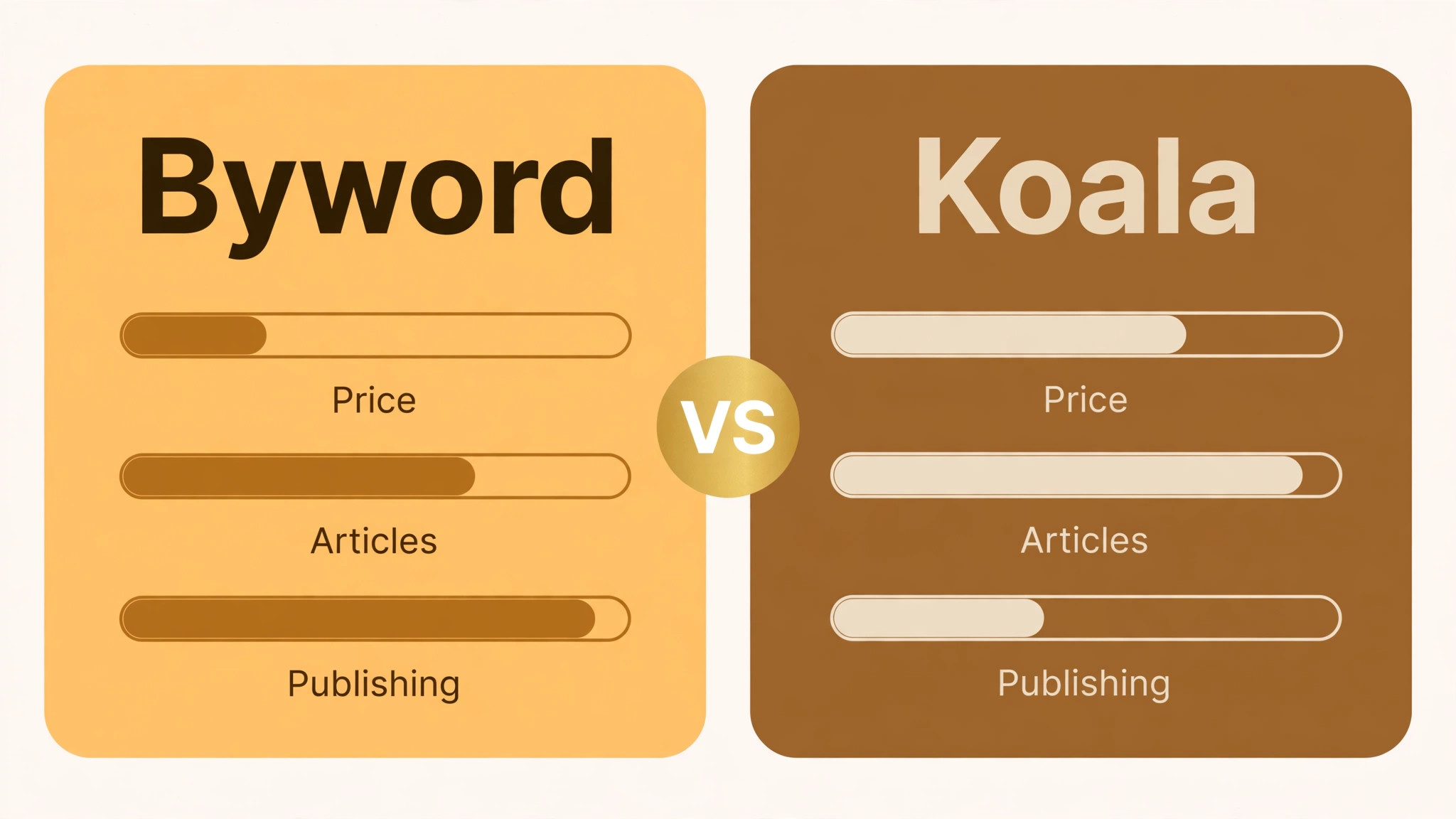
Byword wins on pure volume. It starts at 99 dollars a month for twenty five articles, with plans to three hundred articles, and its programmatic workflow is built for keyword lists rather than single pages. A team that needs a hundred article style pages from a spreadsheet should pick Byword, because its pricing and its workflow both assume bulk.
Koala wins on price per page. It starts at 25 dollars a month for the Starter plan, with word based plans that make a single long article cheap, and its SERP aware drafts need less fixing than most bulk writers. The Top 10 Programmatic SEO Tools split here on volume against cost, and a team that needs twenty pages a month will spend less with Koala than with Byword.
Can AI Writers Replace Human Editors at Scale?
No, and the teams that try learn it within a month. AI writers produce fluent drafts at speed, yet they invent facts, repeat phrases and miss the detail that makes a page useful. A human editor who checks facts, cuts repetition and adds one real example per page will lift a batch from thin to rankable, and that edit is the difference between pages that rank and pages that sit ignored.
The workflow that works is writer plus optimiser plus editor. The writer drafts the batch, the optimiser scores each page against the ranking pages, and the editor reads a sample and fixes the facts. A team that runs this chain will publish slower than a team that ships raw output, and it will rank faster, because Google rewards the pages that survive the check.
What Does Programmatic SEO Cost in 2026?
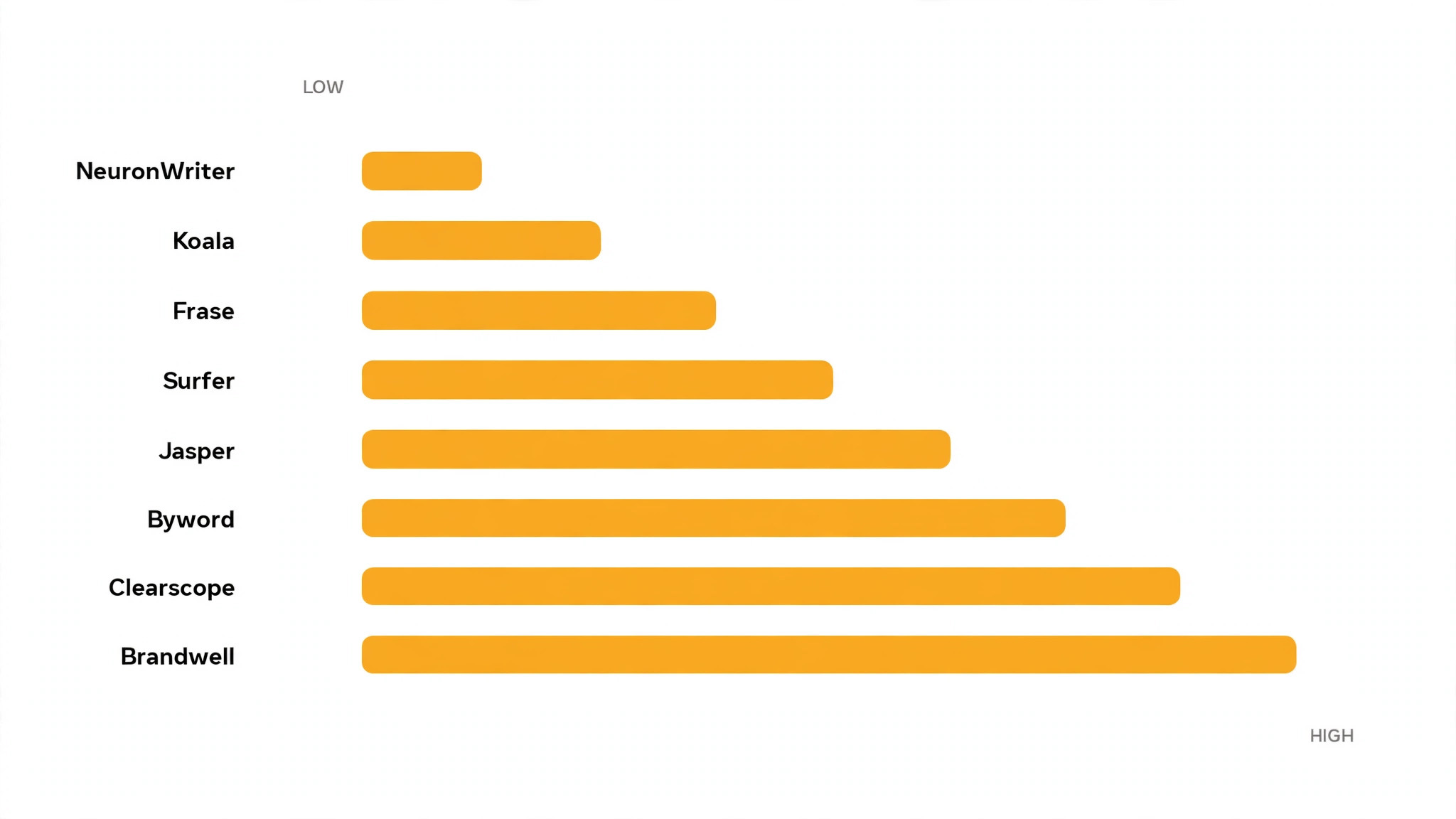
A small setup starts at about 25 to 99 dollars a month. Koala starts at 25 dollars a month, NeuronWriter at 23 dollars a month, and Byword at 99 dollars a month for twenty five articles. The Top 10 Programmatic SEO Tools at this level cover writing and optimisation for a team publishing a few dozen pages a month, and a team should expect that range for the first tool.
A serious setup runs to several hundred dollars a month. Surfer starts at 49 dollars a month, Frase at a reported 39 dollars a month, Clearscope at 129 dollars a month, and Brandwell at 249 dollars a month. A team that publishes a hundred pages a month should budget for a writer plus an optimiser, because the optimiser is what keeps the batch rankable.
Frequently Asked Questions
Which programmatic SEO tool is best for a beginner?
Byword is the best first pick for a beginner, because it turns a keyword list into finished articles with one click publishing, from 99 dollars a month. Among the Top 10 Programmatic SEO Tools, it is the simplest path from a spreadsheet to live pages, and a beginner can add Surfer later once the first batch needs scoring.
How many pages can programmatic SEO publish per month?
A small team can publish fifty to one hundred pages a month with one writer and one editor, while a large team with a full workflow can publish several hundred. The limit is editing rather than writing, because a page that nobody checks will not rank, however fast the writer produced it.
Does Google penalise programmatic SEO?
Google does not penalise the method, and it penalises thin pages whatever the method. A programmatic page with real data, clear answers and internal links will rank, while a page that swaps one keyword into a thin paragraph will be ignored. The quality gate decides the result, not the tool that wrote the page.
Do I need a developer for programmatic SEO?
Not for the writing, and the Top 10 Programmatic SEO Tools in this guide publish to WordPress without code. A developer helps with the template, the data feed and the internal linking rules, and a team with a complex data source should involve one early, because a clean feed saves more time than any writer feature.
What is the best template for programmatic pages?
The best template answers one search question fully, with a clear heading structure, a data table, a short answer at the top and links to related pages. A template that only swaps a city or a product name into the same thin paragraph will not rank, while a template with real facts per page will.
How do I check quality across hundreds of pages?
Score every page with an optimiser, crawl the batch for broken links and duplicates, and read ten pages by hand before the batch goes live. A sample that reads well usually means the batch reads well, while a sample with invented facts means the data feed needs fixing before anything else ships.
The Final Word on Programmatic SEO
Byword takes the volume spot, Koala takes the budget spot, and Surfer takes the quality spot that every batch needs beside the writer. The Top 10 Programmatic SEO Tools all serve the same system, and the winner for any one team is the setup that writes fast, scores every page and publishes without a handoff.
Build one strong template by hand, feed it clean data, and publish a small batch first. Score the batch, read ten pages, fix the template, and only then scale to a hundred. The teams that rank at scale are the teams that respect the template, and the tool is only the engine that runs it.