The Vistaprint vs Moo business cards question is the first decision most small businesses face when they order cards, and it is worth settling properly. Vistaprint and Moo are the two business card printers most small businesses choose between, and they serve different buyers. Vistaprint is the volume printer, cheap, fast and good enough for almost any job. Moo is the premium printer, with thicker stock, better finishes and a card that feels expensive in the hand. Both will print a good card. The question is whether your card needs to impress or just inform, and this guide compares them head to head.
The price gap is real. A pack of 100 standard cards from Vistaprint costs about $20, and frequent sales cut that by 30 to 50 percent. The same 100 cards from Moo start at about $24.99 for 50, which works out near twice the price per card. That gap buys thicker stock, a better finish and a more memorable card. For a business that hands out ten cards a week, the premium is a few dollars a month. For a business that hands out a hundred, it adds up.
Card stock is the difference you feel before you read a word. Vistaprint standard stock is solid and professional, but Moo stock is thicker, with a soft-touch laminate that feels like a luxury brand. A client who receives a Moo card notices the difference, even if they cannot name it. A client who receives a Vistaprint card notices nothing, which is fine, because the card did its job. The choice is between a card that is noticed and a card that is not.
This guide compares Vistaprint vs Moo business cards on price, stock, print quality, design tools and the jobs each one wins, with real prices and an honest verdict for each type of business. No printer wins every round, and the winner for a startup is not the winner for a design studio.
Quick jump
- Quick Answer. Vistaprint vs Moo Business Cards in 30 Seconds
- Pricing. Vistaprint Is Cheaper, Moo Is Worth It When It Matters
- Card Stock and Feel. Moo Wins, and It Is Not Close
- Print Quality. Both Are Good, Moo Is More Consistent
- Design Tools. Both Are Easy, Moo Templates Look Better
- Range and Extras. Vistaprint Wins on Everything Else
- Turnaround and Service. Both Are Reliable
- Best for Each Job. Who Should Choose Which
- Verdict. A Winner for Every Job
- How to Decide in Ten Minutes
- What Real Users Say
- Ordering for an Event. A Timeline
- Decision Worksheet. Answer These Before You Pay
- Premium Finishes. Are They Worth It
- Related Guides
- Questions Owners Ask Most
- The Bottom Line
Quick Answer. Vistaprint vs Moo Business Cards in 30 Seconds
If you want the answer before the detail, here it is. Vistaprint is the best pick for most small businesses, because the cards are cheap, the ordering is fast, and frequent sales cut prices by 30 to 50 percent. Moo is the best pick when the card has to impress, because the stock is thicker, the finishes are better, and the card feels premium. If you hand out cards by the hundred, choose Vistaprint. If you hand out cards by the dozen to clients who matter, choose Moo. The rest of this guide proves that short answer, round by round.
The table below puts the decision in one place. Read it, then read the sections that matter to your job, because the winner changes with the job.
| Vistaprint | Moo | ||
|---|---|---|---|
| Best for | Volume and value | Premium impression | |
| 100 cards from | About $20 | About $50 | |
| Card stock | Good, standard weight | Thick, premium feel | |
| Finishes | Glossy, matte | Soft-touch, foil, spot gloss | |
| Design tool | Simple templates | Polished templates | |
| Turnaround | Fast, 4 to 6 days | About a week | |
| Winner | Most small businesses | Premium brands |
Pricing. Vistaprint Is Cheaper, Moo Is Worth It When It Matters
Vistaprint business cards start at about $20 for 100 standard cards, and the frequent sales cut that to $12 to $14, which is about $0.12 to $0.14 per card. Premium stock, rounded corners and foil cost extra, but the base price is the cheapest here. For a business that orders 500 cards at a time, Vistaprint is the clear value winner, and the savings add up to real money over a year.
Moo business cards start at about $24.99 for 50, which works out near $0.50 per card, and 100 cards cost about $50. That is two to three times the Vistaprint price, and the gap is the point. Moo charges for thicker stock, better finishes and a more careful print process. A business that hands out 20 cards a month pays about $10 a month for Moo. A business that hands out 200 pays $100, and at that volume Vistaprint makes more sense.
Both printers charge for shipping, and both offer faster delivery at a premium. Vistaprint shipping is usually cheaper, and its sales often include free shipping thresholds. Moo shipping is fair for the quality, but it adds to an already premium price. Always compare the delivered total, not the headline price, and never order at full price from Vistaprint, because a sale is always coming.
The honest price question is not which printer is cheaper. It is what a card is worth to your business. A card that wins a client is worth far more than the $0.40 price gap. A card that gets binned is worth nothing, whatever it cost. If your card goes to high-value clients, pay for Moo. If it goes to everyone at a trade show, pay for Vistaprint.
Card Stock and Feel. Moo Wins, and It Is Not Close
Moo card stock is the reason the brand exists. The standard Moo card uses a thick stock with a soft-touch laminate that feels smooth and substantial, and the premium options add even more weight. Hold a Moo card next to a standard card and the difference is obvious in a second. Clients notice, even when they cannot explain why, and a card that feels expensive makes the business behind it feel expensive too.
Vistaprint standard stock is good and professional, but it is thinner and lighter than Moo, and the finish is simpler. Premium stock from Vistaprint closes the gap, with a heavier weight and a matte finish that feels better, but it costs extra and still does not match the Moo soft-touch feel. For most business purposes, Vistaprint stock is fine. For a first impression that matters, Moo is better.
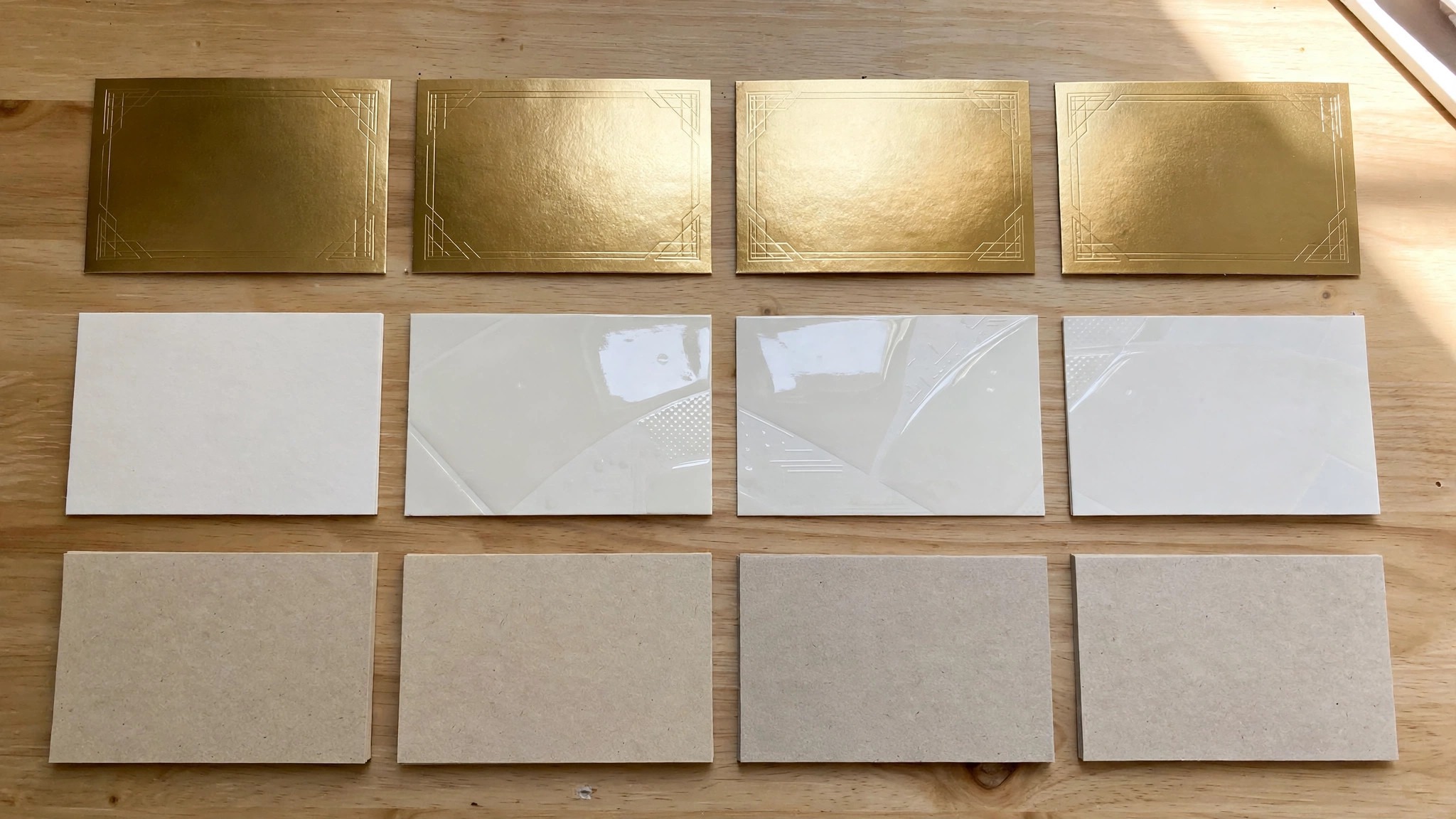
Both printers offer special finishes. Moo offers foil, spot gloss, raised print and rounded corners, all executed well. Vistaprint offers foil, glossy and matte finishes, and the quality is good. The difference is consistency. Moo finishes are applied with more care, and the result is more reliable. If you pay for a special finish, you want it done right, and Moo does it right more often.
Test both before you commit. Order a small pack from each printer, hand the cards to five people, and ask which one feels more expensive. In most tests, Moo wins by a clear margin. Then ask whether that feeling is worth the price gap for your business. For a designer, a consultant or a premium service, the answer is usually yes. For a trade show, it is usually no.

Print Quality. Both Are Good, Moo Is More Consistent
Moo print quality is excellent and consistent. Colours are accurate, text is sharp, and the finish is even across the whole run. The company prints in smaller batches with more care, and it shows. A logo with fine detail, a photo with subtle shading, or a design with a dark background all print well on Moo stock, which is why designers recommend it.
Vistaprint print quality is good, and most customers will never see a difference. Colours are usually accurate, text is sharp, and the cards look professional. The weakness is consistency at volume. A large run can have slight colour variation between cards, and dark backgrounds can show banding. For a standard business card with a logo and contact details, Vistaprint quality is fine. For a design-led card, Moo is safer.
Both printers check your files before printing, and both offer free design help. Moo design support is more hands-on, with real designers reviewing files and suggesting fixes. Vistaprint support is solid but more automated. If your design is complex, or if you are not sure about bleed and safe margins, Moo support is worth the premium.
The practical test is simple. Print the same design at both printers, and compare the cards side by side in daylight. Look at the colour accuracy, the sharpness of small text, and the evenness of the finish. Most businesses will see a small gap in favour of Moo. Whether that gap is worth double the price depends on who receives the card.
Design Tools. Both Are Easy, Moo Templates Look Better
Vistaprint design tools are simple and fast, with hundreds of templates for every industry. Upload a logo, add your details, pick a template, and the card is ready in ten minutes. The editor is basic but effective, and the templates are professional. The weakness is that the most popular templates appear on many businesses, so a Vistaprint card can look familiar.
Moo design tools are more polished, with templates that look a step more designed. The editor is clean, the typography is better, and the results look more considered. Moo also offers Printfinity, which lets you print a different design on every card in a pack, so a photographer can show 50 different photos, or a business can print 50 different services. That feature alone wins Moo many creative customers.
Both printers accept uploaded designs, and both handle print-ready files well. If you have a designer, upload a finished PDF and skip the online tool entirely. If you do not, the template editor is the way to go, and both are easy enough for a non-designer. The difference is taste, and Moo templates have more of it.
Whichever tool you use, keep the design simple. One logo, one name, one phone number, one website, and a clear job title. A card with too much text is a card that does not get read. Leave white space, use a readable font, and let the stock and the finish do the talking.
Range and Extras. Vistaprint Wins on Everything Else
Vistaprint is a full print shop, with flyers, banners, stickers, signs, pens, mugs and hundreds of other products. A business that orders cards can add flyers and banners to the same order, saving shipping and time. That consolidation is a real advantage, and it is why many businesses stay with Vistaprint even when they prefer Moo cards. One supplier, one delivery, one invoice.
Moo has a smaller range, focused on cards, stickers, flyers, notebooks and a few premium products. The range is well chosen and well made, but it does not cover a full print order. A business that needs banners, signs or promotional products will need a second supplier. For a business that only needs cards and a few extras, Moo range is enough.
Both printers offer matching products, so your cards, stickers and flyers can share a design. Moo matching products look more premium, and Vistaprint matching products cost less. The choice is the same as the card choice. Premium feel or low price, and the answer depends on who sees the print.
If you order print regularly, the range matters. A business that orders monthly will save more with Vistaprint consolidation than it loses on card quality. A business that orders cards twice a year can afford to choose Moo for the cards and a second supplier for the rest.
Turnaround and Service. Both Are Reliable
Vistaprint turnaround is fast, with standard delivery in about four to six business days and express options for urgent orders. The ordering process is smooth, the proofing is clear, and customer service is available by phone and chat. For a business that needs cards quickly, Vistaprint is the safer choice.
Moo turnaround is about a week for standard delivery, with faster options available. The process is also smooth, and the customer service is excellent, with real humans who understand print. The extra day or two is the price of the more careful print process, and it is rarely a problem if you order ahead.
Both printers offer reprints if the cards arrive with a print error, and both honour that promise. Keep your proof, check the cards when they arrive, and report any problem within a few days. A good printer fixes its mistakes, and both of these do.
Order ahead. A card order placed the week before a trade show is a risk with any printer, because shipping delays happen. Order three weeks ahead, check the cards when they arrive, and keep a spare pack. A business that runs out of cards at an event loses more than the cost of the cards.
Best for Each Job. Who Should Choose Which
A startup, a trade show exhibitor or a business that hands out cards by the hundred should choose Vistaprint. The price is low, the quality is good, and the range covers every other print need. The $20 pack and the frequent sales make Vistaprint the value winner, and the cards do the job.
A designer, a consultant, a premium service or a business where the card goes to high-value clients should choose Moo. The thick stock, the soft-touch finish and the consistent print quality make a first impression that Vistaprint cannot match. The $50 pack is a small price for a card that wins a client.
A creative business, a photographer or an artist should choose Moo for Printfinity alone. Fifty different designs in one pack turns a business card into a portfolio, and that is worth more than the price gap. A standard card cannot do that, whatever it costs.
A business that is unsure should order a small pack from both, hand them to five people, and ask which one feels more expensive. Then decide whether that feeling is worth the price gap for your business. The test costs about $75 and answers the question better than any guide.
Verdict. A Winner for Every Job
Vistaprint wins for most small businesses. The cards are cheap, the ordering is fast, the range is huge, and the frequent sales make the price hard to beat. If you hand out cards by the hundred, Vistaprint is the right choice, and the $20 pack is good value.
Moo wins for premium brands. The stock is thicker, the finish is better, and the card feels expensive in a way that Vistaprint cannot match. If your card goes to clients who matter, Moo is the right choice, and the $50 pack is money well spent.
The honest verdict is that both printers are good, and the gap between them is the gap between a card that is noticed and a card that is not. Choose based on who receives the card, not on the price alone. A card that wins a client is worth far more than the $0.40 gap, and a card that gets binned is worth nothing, whatever it cost.

How to Decide in Ten Minutes
Set a timer and answer three questions. What is the job, how often will you do it, and who will see the result? The job decides the features you need, the frequency decides whether a subscription is worth it, and the audience decides how much polish matters. Write the answers down, because a decision made from a written list is better than one made from a feeling.
Next, test the two finalists with a real job, not a demo. Design the same flyer, card or page in each tool, using your own words and your own photos, and compare the results side by side. The tool that produces the better result in less time is the one to choose. A free trial is the cheapest way to learn this, and it costs nothing but an hour.
Finally, check the total cost for a year, including the plan, the add-ons and the shipping. The cheapest monthly price is not always the cheapest year, and a tool that replaces a second subscription can be free in practice. In the vistaprint vs moo business cards comparison, the winner is the tool that fits your real week, not the one with the longest feature list.
What Real Users Say
Read the reviews for any tool in the %s comparison and a pattern appears quickly. Users praise the winner for the same reasons every time, speed, reliability and results that look professional without effort. They complain about the same things too, usually price rises, upsells at checkout, or a feature that moved in an update. The complaints matter, because they predict your own frustrations.
The most useful reviews are the detailed ones from businesses like yours, not the five-star summaries. Look for a reviewer who describes their job, their volume and their problem, and see whether the tool solved it. A review that says great tool tells you nothing. A review that says we print 500 flyers a month and the colours are consistent tells you everything.
Treat review scores with care. A tool with thousands of reviews and a 4.5 average is a safer bet than a tool with fifty reviews and a 5.0 average. The larger sample is more honest. And remember that unhappy customers review more often than happy ones, so a 4.5 average usually means most users are satisfied. Use reviews to confirm a choice, not to make it.
Ordering for an Event. A Timeline
Three weeks before the event, order the cards. That leaves time for design, proofing, printing and delivery, with a week spare for a reprint if something goes wrong. A card order placed the week before an event is a risk, because shipping delays happen, and a reprint takes days you do not have.
Two weeks before, check the proof carefully. Read every word, check the phone number digit by digit, and confirm the colours. Most card errors are spelling errors, and most spelling errors are caught by reading the proof aloud. Ask a colleague to read it too, because a fresh pair of eyes catches what yours misses.
One week before, the cards should be in your hands. Check a sample from the pack, count the quantity, and pack a spare set in a different bag. On the day, carry more cards than you think you need, because running out at an event is worse than carrying extras home. In the vistaprint vs moo business cards choice, the timeline is the same, so order early whatever printer you choose.
Decision Worksheet. Answer These Before You Pay
- What is the one job this tool has to do well, in a single sentence
- How often will you use it, daily, weekly or monthly
- Who will see the result, and how much does polish matter to them
- What is the total cost for a year, including add-ons and shipping
- Which plan includes the feature you need, and what does the next plan add
- Have you tested it with a real job, using your own words and photos
In the Vistaprint vs Moo business cards comparison, the pattern is clear. Volume points to Vistaprint, impression points to Moo, and the person receiving the card decides it.
Premium Finishes. Are They Worth It
Foil is the finish that changes a card most. A gold or silver foil logo catches the light and the eye, and it signals a premium brand in a way that flat ink cannot. Moo foil is applied cleanly and consistently, and the result looks expensive. Vistaprint foil is good, but the application is less consistent at volume. If foil is the point of your card, Moo is the safer choice, and the extra cost is visible in the result.
Spot gloss, also called spot UV, adds a raised glossy layer to part of the card, usually the logo or a pattern. The contrast between the glossy spot and the matte card is subtle and tactile, and it rewards a client who holds the card. Both printers offer it, and both do it well. The effect suits a minimal design, where one glossy element stands out against a quiet background.
Soft-touch laminate is the finish that wins the most blind tests. The card feels smooth, almost velvety, and clients notice the difference before they read a word. Moo soft-touch is the best in this comparison, and it is the reason many designers recommend Moo. Vistaprint premium matte is close, but the soft-touch feel is distinct. If you want a card that feels expensive, pay for the finish, and choose the printer that does it best.
Rounded corners cost a little extra and change the feel of a card. A rounded card does not catch in a pocket or a wallet, and it looks considered rather than standard. Both printers offer rounded corners, and the quality is good on both. It is a small detail, but small details add up, and a card with foil, soft-touch laminate and rounded corners feels like a different product from a standard card.
Related Guides
Questions Owners Ask Most
Is Moo better than Vistaprint?
Moo is better for card stock, finishes and print consistency, while Vistaprint is better for price, range and speed. Moo suits premium brands and high-value clients. Vistaprint suits volume, trade shows and businesses that hand out cards by the hundred. Neither is better for every job.
How much do Moo business cards cost?
Moo business cards start at about $24.99 for 50, or about $0.50 per card. A pack of 100 costs about $50. Premium finishes like foil and spot gloss cost extra. The price is two to three times Vistaprint, and the gap buys thicker stock and a better finish.
How much do Vistaprint business cards cost?
Vistaprint business cards start at about $20 for 100 standard cards, or $0.20 per card. Frequent sales cut that to $12 to $14, or about $0.12 to $0.14 per card. Premium stock and finishes cost extra. Vistaprint is the cheapest quality option here.
What is Printfinity on Moo?
Printfinity lets you print a different design on every card in a pack, so 50 cards can show 50 different photos, services or designs. It costs the same as a standard pack, and it suits photographers, artists and creative businesses who want their card to act as a portfolio.
Which business card printer is best for a startup?
Vistaprint is the best choice for most startups, because the price is low, the ordering is fast, and the range covers every other print need. Order 100 cards, use them, and upgrade to Moo later if the business grows into premium clients who expect a premium card.
The Vistaprint vs Moo business cards question has no single winner. The winner is the printer that matches who receives the card, not the one with the lowest price.
Vistaprint vs Moo business cards. Which is better for a small business?
Vistaprint is better for most small businesses, because the cards are cheap, the ordering is fast, and the range covers every other print need. Moo is better when the card has to impress, because the stock is thicker and the finish is better. Order a small pack from both, hand them to five people, and ask which one feels more expensive.
How long do Vistaprint and Moo cards take to arrive?
Vistaprint standard delivery takes about four to six business days, and Moo takes about a week. Both offer express options for urgent orders. Order three weeks before an event, check the cards when they arrive, and keep a spare pack, because shipping delays happen with any printer.
Can I print different designs on every card?
Moo offers Printfinity, which lets you print a different design on every card in a pack at no extra cost, so 50 cards can show 50 different photos or services. Vistaprint does not offer the same feature. For a photographer, artist or creative business, Printfinity alone can justify choosing Moo.
The Bottom Line
Vistaprint is the best pick for most small businesses, because the cards are cheap, the ordering is fast, and the range covers every other print need. Moo is the best pick when the card has to impress, because the stock is thicker, the finishes are better, and the card feels premium. Order a small pack from both, hand them to five people, and ask which one feels more expensive. Then choose based on who receives the card. A card that wins a client is worth far more than the price gap.
1 thought on “Vistaprint vs Moo Business Cards”