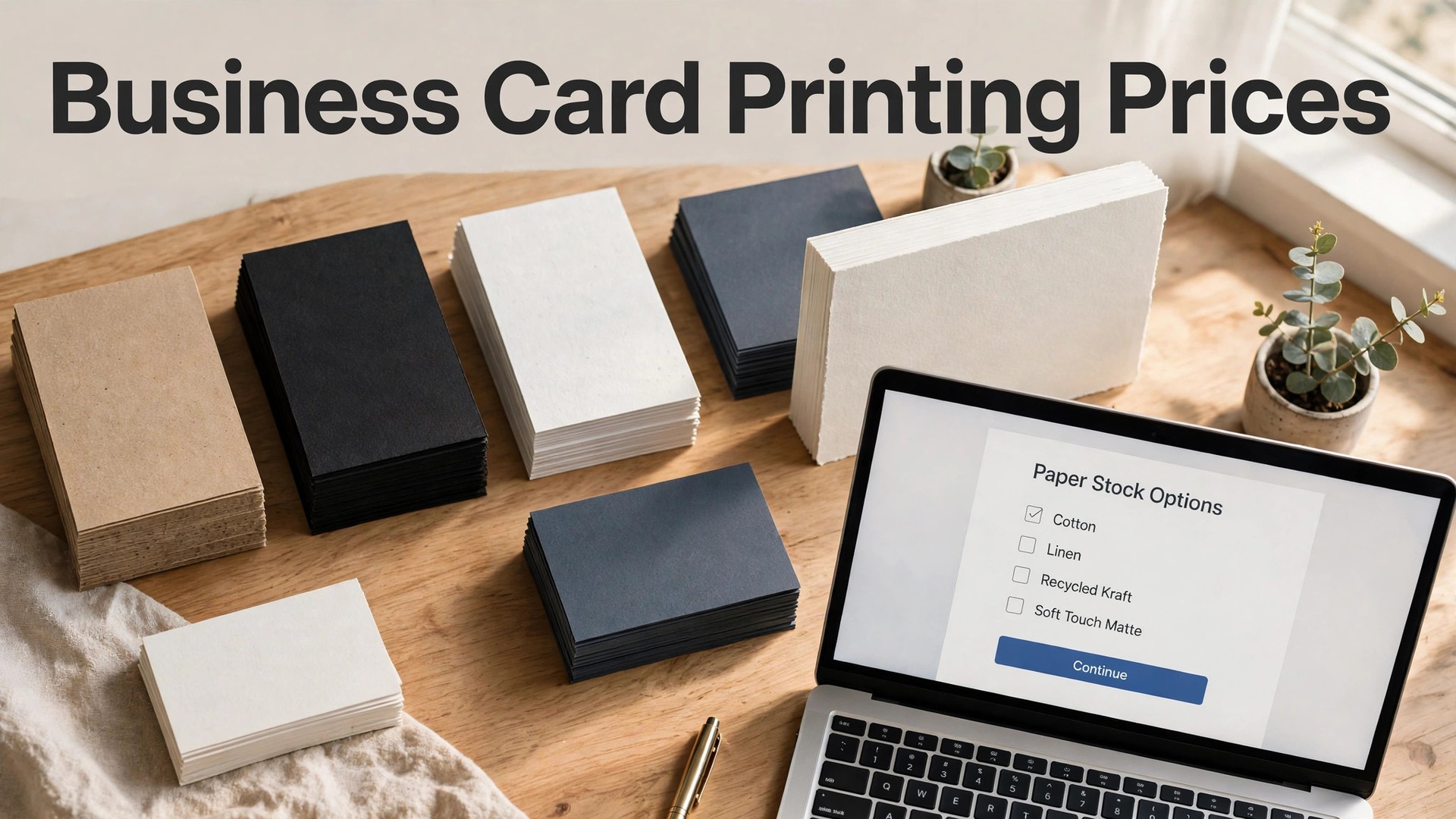
The same 500 business cards cost 25 dollars at one printer and 435 dollars at another, and both prices are honest. The 25 dollar card is a standard 14 point stock, printed on the front only, with economy shipping. The 435 dollar card is a 32 point luxury stock with a coloured seam, printed on both sides, and delivered in two days. Neither printer is overcharging. They are selling different cards to different buyers, and the gap between them is the whole story of business card printing prices in 2026.
The question is not which printer is cheapest. It is which card your business actually needs, and what that card costs once shipping, design, and the back side are added in.
Most buyers overpay in one of two ways. They order the cheapest card and hand out something that feels flimsy, or they order the luxury card when a standard card would have done the job for a tenth of the price. This guide compares the real prices across the popular printers, works out the per card cost at every quantity, and names the extras that change the total, so you order the right card at the right price the first time. The numbers below are business card printing prices as listed in October 2026, before promo codes, tax, and shipping.
In this article
- Quick Answer. Business Card Printing Prices in 2026
- What 500 Cards Cost Across Printers
- The Printers, Priced One by One
- Paper, Finish, and Size. What Changes the Price
- The Quantity Math. Why 500 Is the Sweet Spot
- The Hidden Costs That Change the Total
- How to Choose the Right Printer for Your Business
- Related Guides
- Frequently Asked Questions
- The Bottom Line
Quick Answer. Business Card Printing Prices in 2026
Here is the short version. In 2026, business card printing prices start at about 25 dollars for 500 standard cards at Vistaprint, which is about 5 cents a card, and run to 86 dollars for 100 luxury cards at MOO, which is 86 cents a card. The median list price for 500 standard full colour cards across printers is about 74 dollars. For most small businesses, 500 premium cards at Vistaprint for about 47 dollars is the sweet spot, with a thick, professional feel at under 10 cents a card. Order 500, not 100, because the per card price drops by more than half when you move from 100 to 500.
The rule that saves the most money is simple. The quantity matters more than the printer. A 100 card order costs about 16 cents a card at Vistaprint, while a 1,000 card order costs about 4 cents a card for the same stock. Buy the quantity you will actually hand out in a year, and the printer choice becomes a question of feel, not price.
| Printer | 500 standard cards | Per card | What stands out |
|---|---|---|---|
| Vistaprint Standard 14pt | 24.99 dollars, front only | About 5 cents | Cheapest, widest catalogue |
| Vistaprint Premium Plus 18pt | 46.99 dollars | About 9 cents | Best value for most businesses |
| MOO Luxe 32pt, 100 cards | 86 dollars | 86 cents | Thick luxury card, coloured seam |
| MOO Luxe 32pt, 1,000 cards | 435 dollars | About 44 cents | Luxury at volume |
| GotPrint standard | About 18 to 36 dollars | About 4 to 7 cents | Budget printing, slower delivery |
| Median across printers, 500 cards | About 74 dollars | About 15 cents | Market middle for standard stock |
What 500 Cards Cost Across Printers
Five hundred cards is the standard order, and it is the quantity where the market is easiest to compare. On October 1, 2026, list prices for 500 standard full colour cards ranged from about 23 dollars at the low end to about 200 dollars at the high end, with a median of about 74 dollars. Thick cards at 32 point and above ranged from 126 to 675 dollars for 500, with a median near 231 dollars. One colour letterpress started near 420 dollars for 500, and die stamped hot foil near 565 dollars.
Those numbers are list prices before promo codes, tax, and shipping, and Vistaprint in particular runs sales so often that the sale price is the price most buyers actually pay.
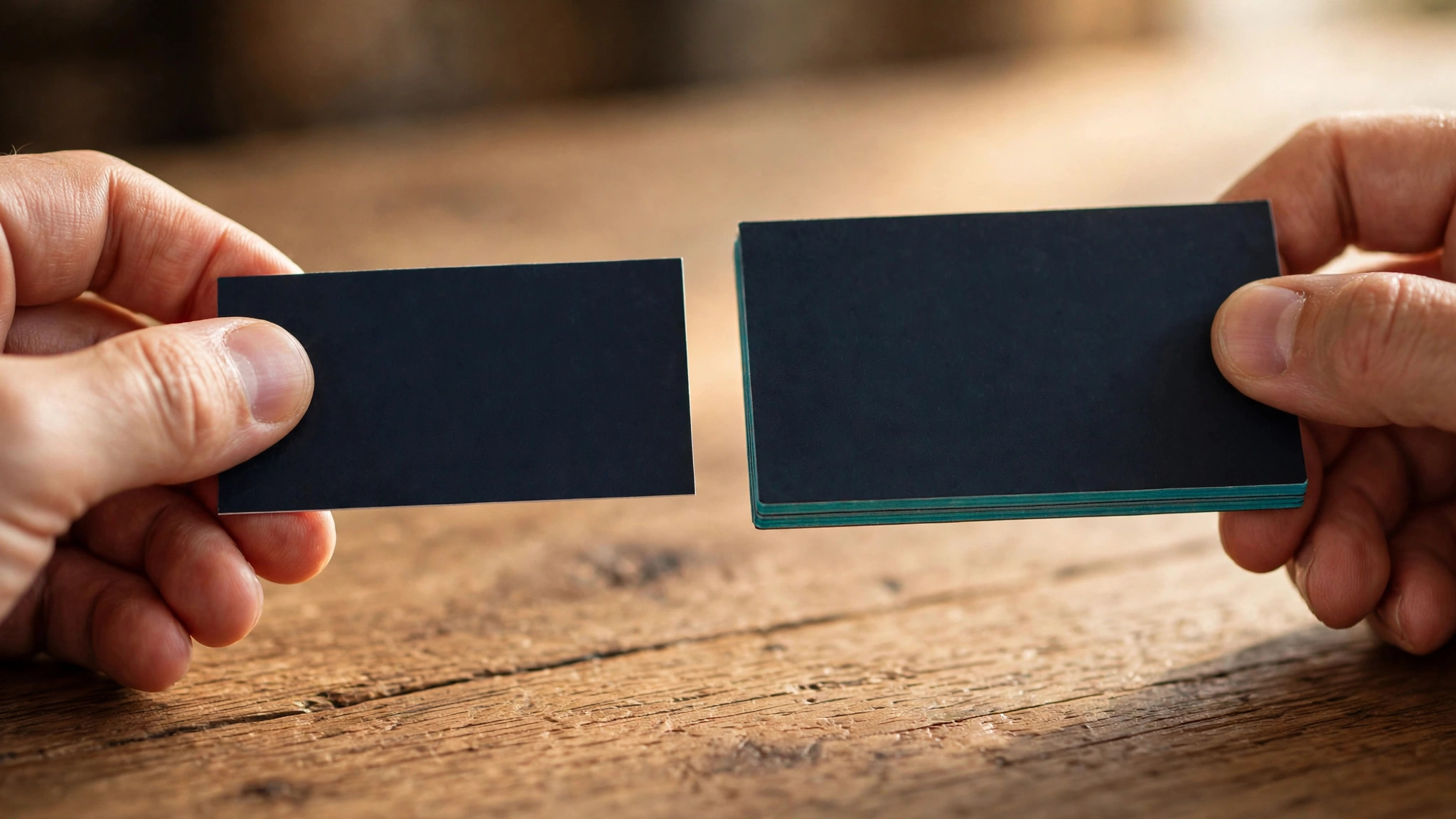
Vistaprint’s Standard 14 point card was 24.99 dollars for 500 on October 1, printed on the front only, with printing on the back costing extra. Its Premium Plus 18 point card was 46.99 dollars for 500. MOO Luxe, the card most people mean when they search for a luxury business card, was 86 dollars for 100 and 435 dollars for 1,000, on 32 point Mohawk Superfine stock built in layers with a coloured seam in one of eight colours, with a stated production time as short as two business days.
The gap between 25 dollars and 435 dollars is not a trick. It is paper thickness, print quality, and speed, and each of those is worth paying for in the right situation.
The lesson from the range is to compare like with like. A 14 point card and a 32 point card are not the same product, and comparing their prices tells you nothing. Decide the stock first, then compare printers on that stock.
A standard 14 point card is fine for a card that gets handed out at a conference and filed away. A thick 18 to 32 point card is right for a card that has to impress, because the first thing a person notices about a card is how it feels between their fingers, not what it says. That is the first rule of reading business card printing prices. Compare the same stock, not the same number.
The Printers, Priced One by One
The printers below are the ones worth comparing in 2026. Prices are list prices for standard 3.5 by 2 inch cards, as shown on each printer’s site in October 2026, before promo codes, tax, and shipping. Production times are what each printer states, not delivery dates.
Vistaprint. The Cheapest and the Widest Catalogue
Vistaprint is the biggest name in online card printing, and its prices are the lowest in the market. Standard 14 point cards run 24.99 dollars for 500, front only, and the Premium Plus 18 point card runs 46.99 dollars for 500. With sale pricing, the numbers drop further.
Vistaprint’s own bulk pricing shows 100 cards at 15.99 dollars, 250 at 21.99 dollars, 500 at 26.99 dollars, and 1,000 at 43.99 dollars, which works out to 16 cents, 9 cents, 6 cents, and 5 cents a card. The 500 card order hits the sweet spot for most small businesses, with enough cards to last months at a per card price that barely matters.
The catalogue is the other reason Vistaprint wins on breadth. Standard, premium, ultra thick 32 point, recycled, linen, pearl, and foil cards are all available, with hundreds of templates and a design tool that lets a beginner build a card in minutes. The trade offs are that the cheapest card feels cheap, because 14 point stock is thin, and the economy delivery estimate runs about 11 business days. Printing the back costs extra, and the ultra thick card takes no foil. Free shipping applies on orders over 100 dollars, which matters when the card order alone is only 25 dollars.
Vistaprint suits a business that needs cards fast and cheap, a startup ordering its first batch, or a team that hands out cards in volume at events. It does not suit a business where the card itself has to impress, because the standard stock will not do that. For those buyers, the Premium Plus card at 46.99 dollars for 500 is the better Vistaprint order, and it still costs under 10 cents a card. That trade is the reason Vistaprint sits at the low end of every business card printing prices comparison, and why its sale price is the price most buyers actually pay.
MOO. The Card That Feels Expensive
MOO is where buyers go when the card has to feel as good as it looks. The standard MOO card starts higher than Vistaprint, with 400 card orders ranging from 128 to 376 dollars depending on stock and finish. The Luxe card is the flagship.
It is 32 point Mohawk Superfine stock, built in layers with a coloured seam, priced at 86 dollars for 100 and 435 dollars for 1,000, with production in as few as two business days. At 86 cents a card for 100, it is the most expensive card in this guide by a wide margin. At 44 cents a card for 1,000, it is still a luxury purchase, but the volume discount is real.
The quality is the reason. MOO cards are thicker, the colours are sharper, and the paper feels substantial in a way that a 14 point card never will. The coloured seam on Luxe is a small detail that people notice and remember, and the print quality holds up under close inspection. MOO also lets you print a different image on the back of every card in an order at no extra charge on some stocks, which suits photographers, designers, and anyone whose work is the product.
MOO suits a business where the card is part of the pitch, such as a designer, a photographer, a consultant, or a premium service. It does not suit a business that hands out cards in volume at trade shows, because 86 cents a card adds up fast when you give away 200 cards in a weekend. For most small businesses, the right MOO order is a small batch of Luxe for key meetings and a larger batch of standard cards for everyday use. That difference is the whole point of MOO, and it is why business card printing prices span from 5 cents to 86 cents a card.
GotPrint and the Budget Printers. Cheap, With a Wait
GotPrint is the budget printer that experienced buyers mention most often, with 500 standard cards in the 18 to 36 dollar range depending on stock and finish, which works out to about 4 to 7 cents a card. The print quality is good for the price, and the range of stocks and finishes is wide. The trade off is delivery, which is slower than Vistaprint or MOO, and a website that feels less polished than the big names. For a buyer who plans ahead, that trade is worth making.
Other budget printers fill the same niche, with 500 card orders from about 19 to 70 dollars depending on the printer and the stock. The pattern is consistent. Budget printers save money and cost time, while premium printers save time and cost money. A business that orders two weeks before an event can use a budget printer and pocket the difference. A business that needs cards by Friday has to pay for speed, and speed is where the premium printers earn their price.
The honest verdict on budget printers is that they are the best value for planned orders and the worst choice for urgent ones. Order early, proof the design carefully, because reprints cost more than the savings, and keep a small stock of cards on hand so a last minute need never forces a rush order. The cheapest card is the one you ordered with time to spare.
Canva Print and Staples. The Convenient Options
Canva Print suits businesses that already design in Canva, because the card goes from design to print without leaving the tool. Prices sit in the middle of the market, above Vistaprint’s sale prices and below MOO, and the quality is solid for standard and premium stocks. The convenience is the selling point. A team that designs everything in Canva saves the export and upload step, and the card matches the rest of the brand because it was built in the same place.
Staples and other office stores suit buyers who need cards today. Same day and next day printing is available in many locations, and the price is higher than online printers for the same card, because you are paying for speed and for a person to hand the cards to you. The quality is fine for a standard card, and the convenience is real when a meeting is tomorrow and the card box is empty. For planned orders, online printers win on price. For emergencies, a local store wins on time, and time is worth paying for once in a while.
Paper, Finish, and Size. What Changes the Price
Paper thickness is measured in points, and it is the single biggest factor in how a card feels. A 14 point card is standard and thin. A 16 to 18 point card feels premium without costing much more. A 32 point card feels like a luxury object. Each step up in thickness adds to the price, and the jump from 18 point to 32 point is larger than the jump from 14 point to 18 point, because the thickest cards are built in layers rather than printed on a single sheet.
Finish is the second factor. A matte finish looks modern and is easy to write on, which matters for a card that gets notes scribbled on the back. A glossy finish makes colours pop and resists fingerprints, but it is hard to write on. Soft touch, also called velvet or suede finish, feels premium and costs more, and it is the finish that makes people comment on a card. Foil, spot gloss, and embossing add the most to the price, and they also add the most to the impression, which is why they belong on a card that has to stand out rather than on a card that gets handed out in volume.
Printing on the back is the third factor, and it is the one buyers forget. Vistaprint’s 24.99 dollar price for 500 standard cards is front only, and adding the back costs extra. A back side is worth the money when it carries something useful, such as a QR code, a map, a list of services, or a second language. It is wasted money when it carries only a logo repeated from the front. Decide what the back has to do before you pay for it, and the extra cost becomes a decision rather than a surprise.
Size is the last factor, and it is the simplest. The standard card is 3.5 by 2 inches, and it fits every wallet and card holder. Square cards, mini cards, and oversized cards cost more and do not fit a standard holder, which means they get kept or thrown away depending on the recipient’s patience. A standard size card in a thick stock beats a novelty size in a thin stock almost every time, because the card that fits in a wallet is the card that gets kept.
| Choice | Cheapest option | Premium option | Price impact |
|---|---|---|---|
| Paper thickness | 14 point standard | 32 point Luxe | 25 dollars vs 86 dollars per 100 |
| Finish | Matte or gloss | Foil or soft touch | Adds 20 to 100 dollars per 500 |
| Back side | Front only | Full colour back | Adds 5 to 15 dollars per 500 |
| Quantity | 100 cards | 1,000 cards | 16 cents vs 5 cents per card |
| Speed | Economy, 11 days | Rush, 2 days | Adds 20 to 50 dollars |
The Quantity Math. Why 500 Is the Sweet Spot
The per card price falls steeply as the quantity rises, and the math is worth seeing plainly. At Vistaprint’s sale pricing, 100 cards cost 15.99 dollars, which is 16 cents a card. 250 cards cost 21.99 dollars, which is 9 cents a card. 500 cards cost 26.99 dollars, which is 6 cents a card. 1,000 cards cost 43.99 dollars, which is 5 cents a card.
Moving from 100 to 500 cards adds only 11 dollars to the bill and gives you five times as many cards. Moving from 500 to 1,000 adds 17 dollars and doubles the cards. The 100 card order is the most expensive way to buy cards, and it is the order most first time buyers choose.
The right quantity is the number you will hand out in a year. A solo consultant who meets five new people a week hands out about 250 cards a year, so 500 lasts two years and costs less than a single lunch. A sales team of five that works trade shows can hand out 500 cards in a weekend, so 1,000 is the right order and the per card price barely matters. A business that rarely meets people in person should order 250 and accept the higher per card price, because 1,000 cards sitting in a drawer are not a bargain, they are waste.
There is one more quantity rule that saves money. Order the same card for the whole team rather than a different card per person, because printers charge per design. Five people sharing one design with different names is one order. Five different designs is five orders, and the price multiplies. Most printers handle name variations inside a single order, so ask before you split the job into separate orders.
One more tip before you order a thousand cards. Make sure the details on the card will stay true for a year. A phone number that changes, a job title that changes, or a website that gets redesigned turns a full box of cards into waste. If a change is coming, order 250 now and reorder after the change, even though the per card price is higher. The box of outdated cards you throw away costs more than the discount you saved.
The Hidden Costs That Change the Total
The card price is the start of the bill, not the end of it, and four extras catch most buyers by surprise. The first is shipping, which runs 5 to 15 dollars for standard delivery and 20 to 50 dollars for rush, and which can double the cost of a 25 dollar card order. Vistaprint offers free shipping on orders over 100 dollars, which is a reason to order 1,000 cards or to combine the card order with other print items rather than paying shipping on a small order alone. Shipping is the most overlooked line in business card printing prices, and it can double a small order.
The second is design. A printer’s free templates cost nothing, and a designer built card costs 50 to 200 dollars from a freelancer, or nothing if you build it in Canva. The design cost matters more than the print cost for a first order, because a card with a bad design wastes the print money entirely. Spend the design time or the design money before you spend the print money, and the cards will be worth handing out.
The third is the reprint. A typo on a card is the most expensive mistake in this guide, because the whole order has to be reprinted and the first batch is waste. Proof the card three times, check the phone number by calling it, check the email by sending a test message, and have a second person read it. A five minute proofread saves a 25 to 86 dollar reprint and the embarrassment of handing out a card with the wrong number.
The fourth is the rush fee. A card ordered with two days to spare costs 20 to 50 dollars more than the same card ordered with two weeks to spare, and the rush fee is pure cost with no benefit to the card itself. Keep a small stock on hand, reorder when the box is half empty rather than empty, and the rush fee never appears. The cheapest business card is the one ordered early, proofed carefully, and shipped at the standard rate.
How to Choose the Right Printer for Your Business
The choice is not about finding the cheapest printer. It is about matching the printer to the job the card has to do. A startup ordering its first batch should use Vistaprint Premium Plus at 46.99 dollars for 500, because it feels professional at under 10 cents a card. A designer, photographer, or consultant whose card is part of the pitch should use MOO Luxe, in a small batch for key meetings. A business that plans ahead and orders in volume should use GotPrint and pocket the difference. A team that designs in Canva should use Canva Print and skip the export step.
Ask three questions before you order. First, who gets the card? A card handed out at a trade show needs to be cheap, because volume is the point. A card handed to a client at the end of a pitch needs to feel expensive, because the card is the last thing they hold. Second, how fast do you need it? Economy shipping at 11 days is fine when you plan ahead, and rush shipping is the price of not planning. Third, what has to be on the back? A QR code, a map, or a service list justifies the extra cost, and a repeated logo does not.
The best pick by job is straightforward. Vistaprint wins for most small businesses because of its price and its range. MOO wins for cards that have to impress. GotPrint wins for planned orders on a budget. Canva Print wins for teams that design in Canva. Staples wins for emergencies. There is no wrong answer among them, only a more expensive one, and the more expensive one is the card you have to reorder because the first batch was wrong.

Related Guides
- How to Design a Letterhead for Your Business
- How to Design a Menu for Your Restaurant
- How to Make a Poster for Your Business
Frequently Asked Questions
How much do 500 business cards cost?
In 2026, 500 standard cards cost 24.99 dollars at Vistaprint for a front only print, or about 26.99 dollars with sale pricing, and the median list price across printers is about 74 dollars. Premium 18 point cards run 46.99 dollars for 500 at Vistaprint. Thick luxury cards cost far more, with 500 thick cards ranging from 126 to 675 dollars and a median near 231 dollars. Shipping, tax, and the back side are extra, so the total for a typical order lands between 30 and 60 dollars for standard stock.
How much does it cost to print business cards at Vistaprint?
Vistaprint’s Standard 14 point card costs 24.99 dollars for 500, front only, and the Premium Plus 18 point card costs 46.99 dollars for 500. With sale pricing, 100 cards cost 15.99 dollars, 250 cost 21.99 dollars, 500 cost 26.99 dollars, and 1,000 cost 43.99 dollars. Printing the back costs extra, and economy delivery runs about 11 business days. Free shipping applies on orders over 100 dollars.
Is MOO worth the extra cost?
It depends on who gets the card. MOO Luxe costs 86 dollars for 100 cards, which is 86 cents a card, against about 5 cents a card for a Vistaprint standard order. The MOO card is thicker, the colours are sharper, and the coloured seam is a detail people remember. For a designer, photographer, or consultant whose card is part of the pitch, that difference is worth paying for in a small batch. For volume handouts at a trade show, it is not, and a standard card is the right call.
What is the cheapest way to print business cards?
The cheapest way is to order 500 standard cards from Vistaprint on sale, at about 26.99 dollars, or from a budget printer such as GotPrint at 18 to 36 dollars for 500. Order 500 rather than 100, because the per card price drops from about 16 cents to about 6 cents. Use the printer’s free templates or Canva to avoid design costs, choose standard shipping, and proof the card three times so you never pay for a reprint.
How thick should a business card be?
Standard cards are 14 point, premium cards are 16 to 18 point, and luxury cards are 32 point. A 14 point card is fine for volume handouts. An 18 point card is the right choice for most small businesses, because it feels professional without costing much more. A 32 point card is right when the card has to impress, such as a first meeting with a major client. Thicker is not always better, because a very thick card can feel stiff in a wallet, so 18 point is the safe default.
How long does business card printing take?
Vistaprint’s economy delivery runs about 11 business days, and faster options cost more. MOO Luxe states production in as few as two business days, with delivery on top. Budget printers are slower, often a week or more. Order at least two weeks before you need the cards, and keep a small stock on hand so a last minute need never forces a rush fee.
The Bottom Line
Business card printing prices in 2026 run from 25 dollars for 500 standard cards to 435 dollars for 1,000 luxury cards, and the right price depends on the card, not the printer. Vistaprint Standard at 24.99 dollars for 500 is the cheapest start. Vistaprint Premium Plus at 46.99 dollars for 500 is the best value for most small businesses, at under 10 cents a card. MOO Luxe at 86 dollars for 100 is the luxury pick for cards that have to impress. GotPrint covers planned orders on a budget.
Order 500, proof the card three times, choose standard shipping, and reorder when the box is half empty. The cheapest card is the one you order early and hand out with confidence. That is the full picture of business card printing prices, and it is worth knowing before you order.

1 thought on “Business Card Printing Prices”